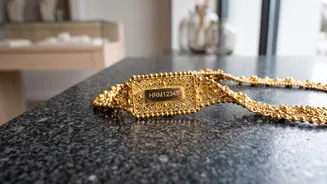





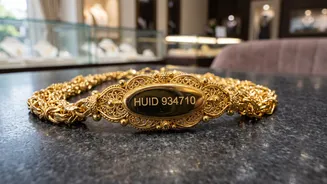

For generations, buying gold in India involved a leap of faith. But a new system from the Bureau of Indian Standards (BIS) is replacing trust with proof. The Hallmark Unique ID, or HUID, is a powerful tool that puts verification in your hands.
Understanding the New Gold Standard
For years,
the purity of gold jewellery was a source of anxiety for many buyers. Stories of being sold lower-karat gold at higher prices were common. To combat this and protect consumers, the Government of India made hallmarking of gold jewellery mandatory. This certification, overseen by the Bureau of Indian Standards (BIS), ensures that the metal's purity has been independently tested and verified. The most significant evolution in this system is the introduction of the Hallmark Unique Identification (HUID) number. Since July 2021, and becoming the sole standard for new jewellery sold from April 2023, the HUID has transformed a batch certification process into one that verifies each individual item. This shift provides unprecedented transparency, giving every single piece of jewellery its own traceable digital identity.
What is the Hallmark Unique ID (HUID)?
The HUID is a six-character alphanumeric code—a mix of letters and numbers—that is laser-engraved onto every piece of hallmarked jewellery at a BIS-recognised Assaying and Hallmarking Centre (AHC). No two pieces of jewellery can have the same HUID. If you buy a pair of earrings, each earring will have its own unique HUID. This code acts like a digital fingerprint, linking the specific ornament to a central BIS database that contains its entire history. It has replaced the older system which included separate marks for the jeweller and the assaying centre, streamlining the hallmark into a more secure, digitally verifiable format.
The Three Marks of Authenticity
When you inspect a new piece of gold jewellery, you should look for three specific marks that comprise the current BIS hallmark. First is the iconic triangular BIS logo, which confirms the piece has been certified under BIS standards. Second is the purity or fineness grade. This will be marked as '22K916' for 22-karat gold (91.6% pure), '18K750' for 18-karat gold (75% pure), or '14K585' for 14-karat gold (58.5% pure), among other grades. The third and most critical component is the six-character HUID itself. Together, these three marks serve as your guarantee of purity and traceability.
How to Verify Your Gold in Minutes
Verifying your gold's HUID is a simple process that you can do right at the jeweller's counter before making a purchase. The key is the official 'BIS CARE' app, which is available for free on both Android and iOS devices. Here's how it works: 1. Download the 'BIS CARE' app from the official Google Play Store or Apple App Store. 2. Open the app and select the 'Verify HUID' feature, which is prominently displayed. 3. Carefully enter the six-character HUID that is engraved on the jewellery. You may need a magnifying glass, and any reputable jeweller should be happy to help you read it. 4. Once submitted, the app will display the details associated with that HUID from the BIS database.
Decoding the Verification Results
The information returned by the BIS CARE app is your confirmation of authenticity. The app should display the type of article (e.g., ring, bangle), the tested purity (e.g., 22K916), and details of the jeweller who had the item hallmarked. You should cross-check this information against the item in your hand and the details provided on your invoice. A mismatch in any of these details—or if the app returns no record at all—is a significant red flag. In such a case, you should not proceed with the purchase and can even use the app's 'Complaints' feature to report the discrepancy directly to BIS.