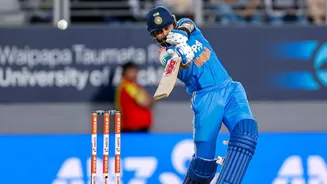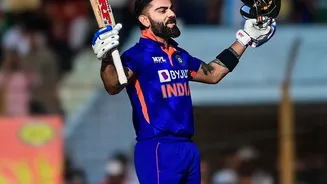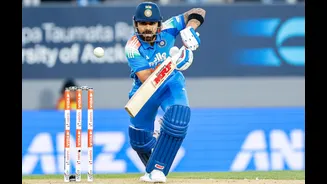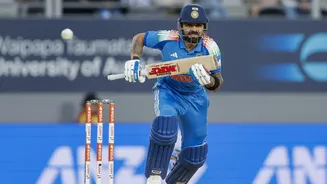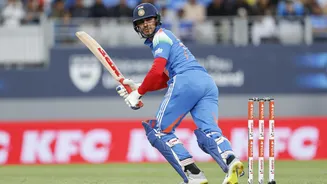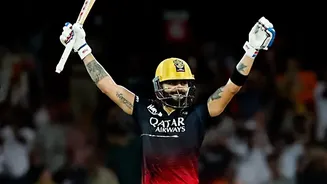






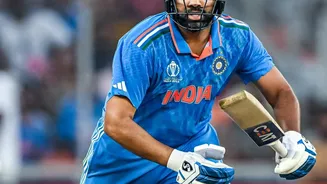
As the undisputed 'King' of modern cricket, Virat Kohli, celebrates his 38th birthday, the world reflects on a career built on staggering consistency and unmatched ambition. Here are five records that highlight his genius.
Most Centuries in ODIs
Topping the list is a record
once considered untouchable: the most centuries in One Day Internationals. Kohli surpassed his own idol, Sachin Tendulkar, who held the record with 49 tons for over a decade. By late 2026, Kohli had amassed 55 ODI centuries, establishing a new peak in 50-over cricket. In an era where T20 leagues are shortening careers and changing player priorities, the focus required to score a century in ODIs is a rare commodity. For a player to not only debut but also maintain the elite fitness, form, and hunger needed to score 56 centuries seems like a task for a generation, making this one of Kohli's most secure legacies. The sheer volume of hundreds, combined with his incredible conversion rate, puts this record in a class of its own.
Fastest to 10,000 ODI Runs
Speed and consistency are the hallmarks of Virat Kohli's batting, and no record demonstrates this better than being the fastest to 10,000 ODI runs. He achieved this feat in just 205 innings, shattering the previous record held by Sachin Tendulkar, who took 259 innings. This wasn't just a marginal improvement; Kohli reached the milestone a staggering 54 innings faster than the next best. To put it into perspective, at the time Kohli crossed 10,000 runs, the next highest run-scorer after 205 innings was AB de Villiers with 9,080 runs. This record isn't just about scoring quickly in individual matches but about eliminating failure over a decade-long period. A future player would need to average nearly 50 runs per innings for over 200 matches without any significant dip in form, a truly Herculean task.
Most Double Centuries as Test Captain
While his white-ball heroics are legendary, Kohli’s dominance in Test cricket, particularly as captain, was equally profound. He holds the record for the most double centuries as a Test captain, with an incredible seven such scores. He surpassed the legendary West Indian batsman Brian Lara, who had five. This record speaks volumes about Kohli's leadership, fitness, and immense concentration. Captaincy brings immense pressure, often affecting a player's individual performance. For Kohli, it was the opposite; he thrived on the responsibility. Scoring a double hundred requires immense physical and mental endurance, and to do so seven times while also managing the strategic demands of leading the team is a feat of extraordinary stamina and skill that places him in a league of his own.
Most 'Player of the Series' Awards in T20Is
Virat Kohli's impact is often best measured by his ability to dominate an entire series, not just a single match. This is perfectly illustrated by his record of winning the most 'Player of the Series' awards in T20 Internationals. He has won the award a staggering seven times. This record underscores his consistent, high-impact performances across multiple games against the world's best teams. Unlike a one-off 'Player of the Match' performance, a series award requires a player to be the most influential cricketer over a period of two to five matches. This sustained excellence in the most unpredictable format of the game highlights Kohli's mastery and his ability to adapt and perform under varying conditions, making him the format's most decorated player in terms of series-long impact.
Highest T20I Batting Average
For a significant part of his career, Virat Kohli maintained the highest batting average in T20I history for any player with over 1,000 runs, a figure that hovered close to 50. As of late 2026, his average stood at a remarkable 48.69. In a format known for high risk shots and frequent dismissals, maintaining such a high average is almost paradoxical. It reflects his unique ability to score at a brisk pace without throwing his wicket away. His high number of not outs (31 in 117 innings) was a testament to his role as a finisher, anchoring the innings and seeing his team through to the end. While other players might have higher strike rates, no one combined aggression with such a low risk of dismissal. For another player to sustain this level of consistency over more than 100 matches is a monumental challenge.