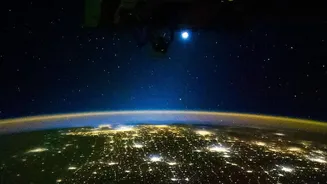



The night sky, a canvas of stars and planets, may soon feature a new and growing collection of bright objects. A new frontier in technology, orbital computing, is here, and it promises to move the engine of the digital world into low Earth orbit.
What Exactly Is Orbital Computing?
At its
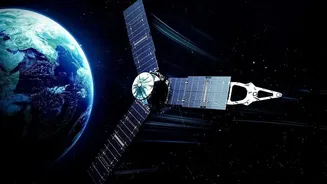
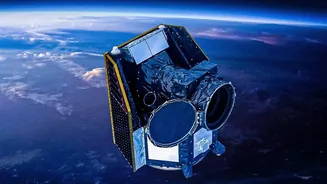
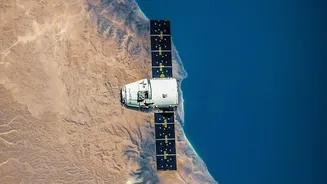
core, orbital computing is the concept of placing data centers into space. Instead of massive, power-hungry buildings on the ground, companies are planning to launch networks of satellites that function as a distributed computing cluster in low Earth orbit. Unlike traditional satellites that mainly relay signals or process data from their own sensors, these 'orbital data centers' would host and process information for third-party customers, much like Amazon Web Services or Google Cloud does on Earth. This isn't just about storage; it involves deploying high-performance hardware like GPUs to handle complex tasks such as artificial intelligence (AI) model training and scientific simulations directly in orbit.
The Business Case for Space Data Centers
The push to orbit is driven by significant terrestrial bottlenecks. On Earth, data centers are straining power grids, consuming vast amounts of water for cooling, and facing lengthy delays for permits and grid connections. Proponents argue that space offers a compelling solution. Satellites can have near-continuous access to solar power, and the vacuum of space provides a passive, zero-cost cooling environment. For some applications, processing data closer to its source in orbit—such as from Earth-observation satellites—can drastically reduce latency and bandwidth costs by sending down only valuable insights instead of raw data streams. Furthermore, the physical inaccessibility of satellites offers a unique security advantage, creating what some call an 'orbital root of trust' for sensitive data.
Who Are the Key Players?
The race to build an orbital cloud is heating up with a mix of ambitious startups and tech giants. Companies like Starcloud, Orbital, and Axiom Space are among the new ventures aiming to run AI workloads and provide edge computing from space. Some have already launched test hardware, with Starcloud having put an Nvidia H100 GPU into orbit. Meanwhile, major tech players are not sitting idle. Google has its 'Project Suncatcher', which launched prototype satellites with its custom TPU chips in October 2026 to test AI workloads in space. SpaceX has filed for a service named 'Starmind' and, according to CEO Elon Musk, plans to enter mass production of a space computer in 2027, leveraging the launch capacity of its Starship rocket.
A New Form of Light Pollution
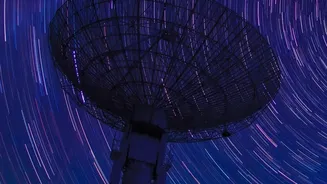
While innovative, this expansion comes with a significant environmental cost: light pollution. Tens of thousands of new satellites, each a potential point of reflected sunlight, threaten to fundamentally alter the night sky. Astronomers have been raising alarms since the first large satellite constellations were launched. These satellites can leave bright streaks across telescope images, ruining scientific observations and making it harder to detect faint objects like distant galaxies or potentially hazardous asteroids. Beyond professional astronomy, the problem affects everyone. A sky filled with artificial moving lights could disrupt cultural heritage practices tied to the stars and even impact ecosystems that rely on natural darkness. The International Astronomical Union (IAU) has called the consequences 'worrisome' and considers a dark sky a 'non-renounceable world human heritage'.
Can the Impact Be Mitigated?
The astronomy community and some satellite operators are actively working on solutions, though no fix is perfect. One key factor is orbital altitude; satellites below 600 kilometers fall into Earth's shadow for a larger portion of the night, reducing their visibility. Another approach involves modifying the satellites themselves. SpaceX, for example, has experimented with darker, less-reflective materials and dielectric mirror films that scatter sunlight away from Earth. Researchers are also developing new 'ultra-black' coatings, like a version of Vantablack, that could make satellites significantly fainter by absorbing most of the light that hits them. However, even with these measures, the sheer number of planned satellites means that nighttime images without a satellite trail may become a thing of the past. The IAU recommends that satellites remain fainter than magnitude 7, effectively invisible to the naked eye, but many current and proposed satellites are far brighter.