


A Jellyfish Adrift in the Cosmos
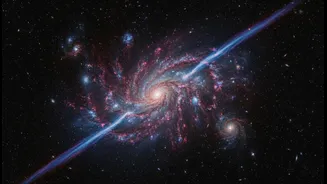
The latest celestial portrait from Hubble features a so-called “jellyfish galaxy.” The image is striking, showing a recognizable galactic disk that is leaving behind long, trailing tendrils of gas and stars. These brilliant blue streamers look like tentacles,
giving the galaxy its aquatic nickname as it speeds through a cluster of other galaxies. This is not a peaceful drift through the cosmic ocean; it is a violent and transformative journey that Hubble has now captured with unprecedented clarity, showing us a dramatic event unfolding on a galactic scale.
The Science of Ram Pressure
So what causes a galaxy to grow tentacles? The phenomenon is known as ram pressure stripping. Imagine a galaxy as a car driving at high speed through a thick fog. The 'fog' in this case is the incredibly hot, diffuse gas that permeates galaxy clusters, known as the intracluster medium. As the galaxy plunges through this medium at millions of kilometers per hour, the resulting pressure acts like a powerful wind, stripping away the galaxy’s own gas and dust. This process is powerful enough to peel back the galaxy's lifeblood—the cold gas needed for making new stars—and cast it adrift into the space behind it.
A Trail of Newborn Stars
Here is where the latest Hubble image delivers a stunning surprise. Logically, stripping a galaxy of its star-forming gas should bring an end to its ability to create new stars, effectively killing it. However, Hubble’s sharp vision reveals that the opposite is happening within these gaseous tentacles. The image is dotted with bright blue knots, each a bustling nursery of newborn stars. The ram pressure, while violent, is compressing the stripped gas to the point that it collapses under its own gravity to ignite star formation. So, in a strange cosmic paradox, the very process that is tearing the galaxy apart is also triggering a spectacular burst of new life in its wake.
An Unlikely Stellar Nursery
These trailing streams of stars are one of the most intriguing aspects of jellyfish galaxies. The stars forming within them are born outside the main galactic disk, in a chaotic and hostile environment. Studying these stellar nurseries helps astronomers understand how stars can form under extreme conditions, so different from the relatively calm environment of our own Milky Way. This recent observation provides some of the clearest evidence yet of this triggered star formation, giving scientists a perfect natural laboratory for studying the life cycle of galaxies and the surprising resilience of the star-making process.
Hubble's Enduring Legacy
For over three decades, the Hubble Space Telescope has been transforming our understanding of the universe, and this new discovery proves its work is far from over. Even with newer telescopes on the scene, Hubble’s unique capabilities continue to provide critical insights into the cosmos. These observations of jellyfish galaxies are essential for building a complete picture of how galaxies evolve. They show that a galaxy's environment is just as important as its internal properties, demonstrating that the universe is a dynamic, interconnected, and often violent place that is constantly changing.