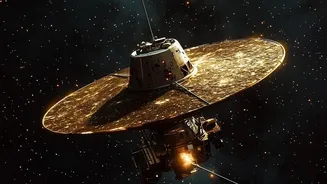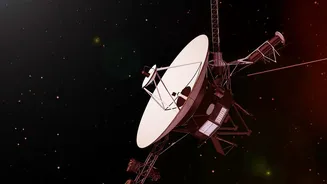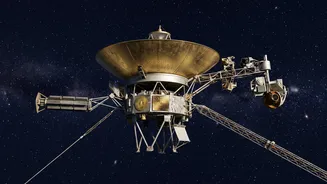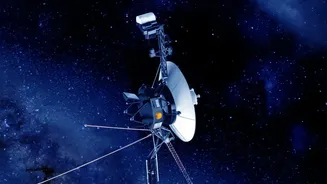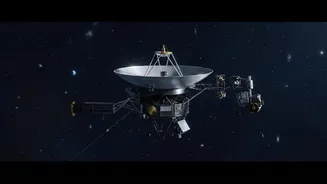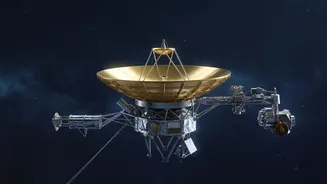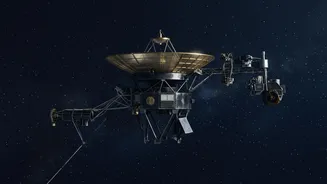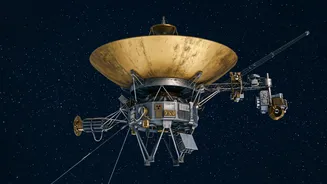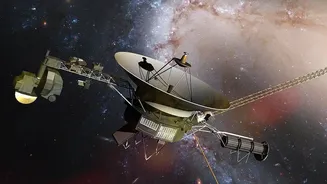




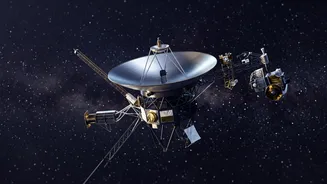
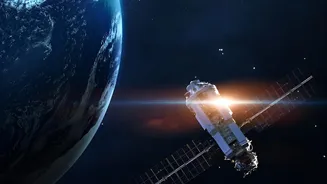
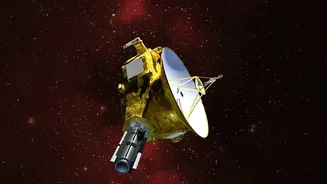
It’s hard to fathom just how far away Voyager 1 is. After nearly 50 years, it’s now in interstellar space. So when it suddenly went silent in October 2026, it wasn’t just a glitch; it was a drama unfolding across 24 billion kilometres.
A Silence Across Billions of Kilometres
For two nail-biting
days in mid-October, humanity's most distant envoy fell silent. On October 18 and 19, 2026, NASA's Deep Space Network (DSN)—a global array of giant radio antennas—strained to hear from Voyager 1 during two scheduled check-ins, but received nothing. For a spacecraft launched in 1977, now navigating the void between stars, any loss of contact is a serious concern. The mission team held its breath. Then, on October 20, before engineers could even send troubleshooting commands, Voyager 1's signal reappeared on its own. The probe had inexplicably resumed communication after a 48-hour outage, a welcome but puzzling resolution.
The Challenge of an Interstellar Explorer
Communicating with Voyager 1 is an exercise in patience and precision. On November 18, 2026, the probe will reach a staggering milestone: it will be one 'light-day' from Earth, a distance of nearly 26 billion kilometres. This means a radio signal, traveling at the speed of light, takes a full 24 hours to reach the spacecraft. A reply takes another 24 hours. Any conversation involves a two-day wait. This incredible distance, combined with the probe's age, makes every anomaly a potential crisis. Its plutonium power source fades by about four watts each year, forcing engineers to make difficult choices about which systems and instruments to shut down to conserve energy. Voyager 1 operates on the very edge of possibility, a testament to its robust 1970s engineering.
Diagnosing a Distant Patient
While relieved to have contact restored, NASA's engineers immediately began investigating the cause of the silence. Initial findings suggest the spacecraft's autonomous fault-protection systems kicked in as designed. It appears one group of its attitude-control thrusters went offline, which automatically triggered a swap to a backup set. This safety feature places the spacecraft into a stable 'safe mode', pausing normal operations to give engineers on Earth time to assess the situation. What remains a mystery is what caused the initial thruster issue. As Voyager Mission Manager Kareem Badaruddin noted, this was the first time the team has seen this specific behavior, but at this late stage of the mission, they must 'expect the unexpected'.
Keeping a Legend Alive
The recent communications scare came just weeks after the mission team completed a crucial power saving manoeuvre nicknamed the 'Big Bang'. In September 2026, engineers carefully switched off three heating related devices and activated lower power alternatives. This complex simultaneous swap was designed to manage the spacecraft's dwindling power budget without compromising heat distribution, which is essential for keeping its electronics operational in the freezing temperatures of interstellar space. This creative engineering is expected to delay the need to shut down another of Voyager's remaining science instruments, potentially extending its data gathering mission beyond the summer of 2027.
Why Voyager Still Matters
Launched in 1977, Voyager 1 and its twin, Voyager 2, completed a 'grand tour' of the outer planets, revolutionising our understanding of Jupiter and Saturn. Voyager 1 discovered the first active volcanoes beyond Earth on Jupiter's moon Io and revealed the complexity of Saturn's rings. In 2012, it made history by becoming the first human made object to enter interstellar space, the region outside the Sun's protective bubble. It continues to be our only direct source of data from this unexplored territory, measuring the conditions that exist between the stars. Each signal it sends back is a priceless dispatch from the frontier, a whisper from a place no other probe has ever reached.