

A Faint New Signal
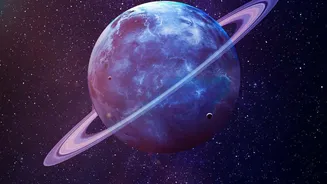
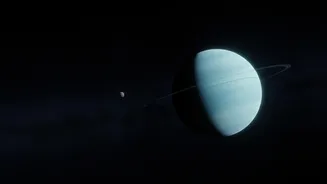
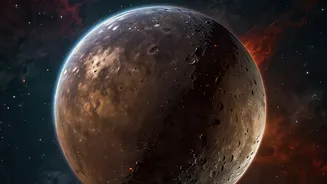
Deep in the cold, distant reaches of space, nearly three billion kilometres from Earth, Uranus holds a complex system of rings and moons. Recently, astronomers added a new member to this family, provisionally named S/2023 U1. This discovery marks the first
new moon found around the ice giant in over two decades. At a mere eight kilometres in diameter, it is one of the faintest and smallest moons ever detected around the planet using ground-based telescopes. The find required incredible technical skill, using powerful instruments like the Magellan telescopes in Chile. Scientists captured dozens of five-minute exposures over several hours and nights, later using special image-processing techniques to stack the pictures. This method allows faint, moving objects like a tiny moon to emerge from the background noise of distant stars and galaxies, confirming its presence and movement.
An Odd Path Through the Ice
What makes S/2023 U1 particularly fascinating is its orbit. It takes approximately 680 Earth days for this tiny body to circle Uranus. This places it among the planet's 'irregular' moons—a group of distant satellites with orbits that are highly inclined and eccentric compared to the larger, inner moons. Most of Uranus's regular moons orbit neatly around its equator, which is itself famously tilted on its side. The irregulars, however, are a motley crew. They often have retrograde orbits (moving opposite to the planet's rotation) and are thought to be captured objects, like asteroids or bodies from the Kuiper Belt, that were ensnared by Uranus's gravity long ago. The unusual path of this new moon offers clues about its origins. Its specific orbital characteristics—its distance, inclination, and shape—are now being meticulously mapped to determine if it belongs to a known family of collisional fragments or if it represents a new type of captured object with a unique history.
The Detective Work of Orbital Mechanics
Investigating an object this faint and distant is a masterclass in cosmic detective work. The initial discovery is just the first step. To truly understand the moon's unusual path, astronomers must engage in a painstaking process of observation and calculation. After the first detection, scientists must re-observe the object over weeks and months to confirm it is indeed orbiting the planet and not just a passing asteroid. By taking multiple measurements of its position against background stars, they can plot its trajectory. These data points are then fed into complex computer models. These simulations calculate the gravitational influences of not only Uranus itself but also the Sun and the planet’s other 27 moons. This helps to refine the orbit and even allows scientists to look back at older images, taken years earlier, to see if the moon was unknowingly captured in previous surveys.
What the Orbit Reveals
The final, calculated orbit is more than just a line on a chart; it's a window into the solar system's chaotic past. An orbit like that of S/2023 U1 could tell several stories. If its orbit clusters with a few other irregular moons, it might suggest they are all fragments of a single, larger moon that was shattered by a collision millions or billions of years ago. Alternatively, its unique path could indicate it was captured more recently than its neighbours. The dynamics of these outer moon systems are incredibly complex; their orbits are constantly perturbed, and computer simulations show that some orbits are inherently unstable over long timescales. Understanding how this tiny moon survives in its current path helps planetary scientists refine their models of how planetary systems form and evolve. Each new discovery, no matter how small, provides a crucial piece of the puzzle, revealing the gravitational dance that has shaped our solar system for eons.