




What Are Orbital Data Centres?
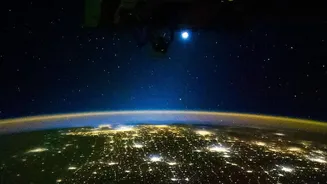
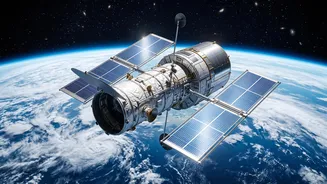
The concept of an orbital data center involves launching thousands, or even hundreds of thousands, of satellites that work together as a massive, space-based computing and storage network. Instead of building more power-hungry server farms on the ground,
companies are exploring moving these workloads into low-Earth orbit. The primary drivers are energy and efficiency. In space, satellites have continuous access to solar power and the vacuum provides a naturally cold environment, simplifying the massive cooling challenge that terrestrial data centers face. These orbital platforms could handle intensive tasks like AI model training and scientific simulations, beaming the results back to Earth.
A Sky Full of Satellites
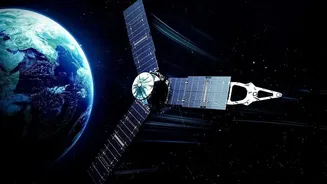
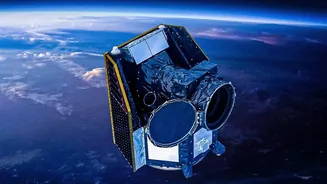
The idea isn't just theoretical; it's rapidly moving toward reality. Major tech players and startups like SpaceX, Google, and Starcloud have announced ambitious projects. SpaceX has filed plans for a constellation of up to one million AI data center satellites, a network nearly 100 times larger than its current Starlink system. Other companies like Starcloud and China's ADA Space are also launching test satellites and have filed for their own large-scale deployments. These 'megaconstellations' represent a fundamental shift, moving beyond communication satellites to creating a permanent, heavy-duty computing infrastructure in orbit. If these plans come to fruition, the number of active satellites could increase exponentially within a decade.
The Astronomer's Dilemma
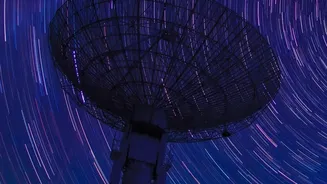
For astronomers, this represents an unprecedented threat to their work. The core problem is light pollution, but on a new scale. Satellites don't produce their own light, but their metallic surfaces and massive solar panels are highly reflective. To a ground-based telescope, a satellite crossing its field of view creates a bright streak across the image, completely obscuring the faint light from distant cosmic objects. This can ruin long-exposure photographs, which are essential for capturing extremely dim and faraway galaxies. Even when the streaks can be digitally removed, they leave behind residual noise that degrades the quality of the scientific data.
Why Faint Galaxies Matter
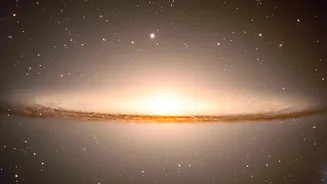
Photographing faint galaxies isn't just about creating beautiful pictures of space. These observations are fundamental to modern astrophysics. Studying the faintest, most distant galaxies allows scientists to look back in time, providing critical information about the early universe, the formation of stars, and the evolution of cosmic structures. This research helps us understand fundamental concepts like dark matter and dark energy. Furthermore, wide-field surveys that are particularly vulnerable to satellite interference are also our primary method for discovering and tracking near-Earth asteroids, some of which could pose a potential impact threat. Blocking our view of these faint objects is, in effect, closing a window into our own cosmic origins and planetary safety.
A New Kind of Light Pollution
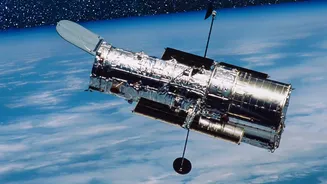
The issue extends beyond just individual streaks. The sheer number of proposed satellites could collectively raise the overall brightness of the night sky, creating a permanent, diffuse glow. This would effectively create a new form of space-based light pollution that can't be escaped by moving telescopes to remote locations. The problem isn't confined to optical telescopes, either. The electronics on board these massive constellations can leak radio signals, creating noise that overwhelms the incredibly faint radio waves astronomers study from objects like pulsars and black holes. Even space telescopes like Hubble are not immune; they orbit below many of these proposed constellations and already suffer from satellite trails in their images.
Searching for a Solution
The astronomical community is actively working with industry and regulatory bodies to find ways to mitigate the impact. Proposed solutions include technical fixes like applying ultra-dark, non_reflective coatings to satellite surfaces to make them less bright. Some research has shown that special paints can absorb over 98% of the light that hits them. Other strategies involve designing satellites with sunshades or placing them in lower orbits so they spend more time in Earth's shadow and are not illuminated during the darkest parts of the night. However, even with these measures, many astronomers believe that without a cap on the total number of satellites, the interference will still pose a significant threat to science. International bodies and regulators are now beginning to discuss these issues, but effective global policies have yet to be established.