



Capturing the Fleeting Moment
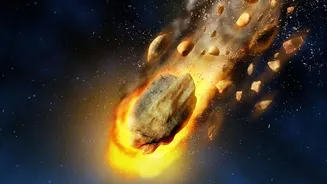
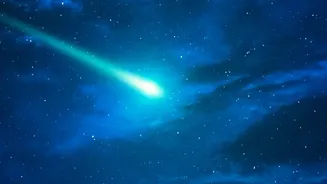
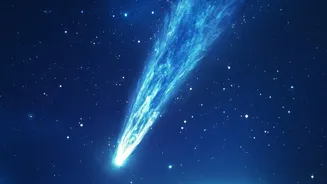
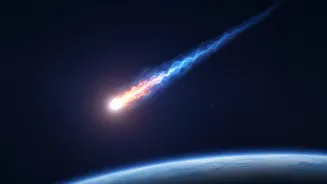
The first step in this cosmic investigation is to precisely record the meteor itself. Astronomers can't predict exactly where a sporadic meteor will appear, so they rely on networks of automated, wide-field cameras that watch the sky all night. These
systems, like NASA's All Sky Fireball Network, are positioned at different locations. When a meteor burns through the atmosphere, multiple cameras capture its journey. By combining the data from these different viewpoints, scientists can use triangulation to determine the meteor's exact path through the atmosphere, its speed, and its brightness. For smaller, non-visible meteors, specialised radar systems can also detect their trails, tracking their speed and direction.
Rewinding the Celestial Clock
Once the trajectory through Earth's atmosphere is known, the real detective work begins. Using the laws of physics and celestial mechanics, astronomers can calculate the meteoroid's velocity and direction just before it hit our atmosphere. From there, they can rewind its journey, accounting for Earth's gravity and motion. This allows them to reconstruct the object's original orbit around the Sun. This calculated orbit is a key piece of the puzzle—a unique path through the solar system that acts like a celestial address. This backward calculation transforms a random streak of light into an object with a history and a path that can be compared to other known bodies in space.
Analysing the Fiery Fingerprint
A meteor isn't just a point of light; its fiery demise contains crucial clues about what it was made of. As the meteoroid vaporises in the atmosphere, the intense heat causes the element within it to glow, each emitting light at specific colours or wavelengths. By placing a device called a diffraction grating in front of their cameras, astronomers can split this light into a spectrum, much like a prism creates a rainbow. This spectrum is a chemical fingerprint. Bright lines in the spectrum reveal the presence of elements like iron, magnesium, calcium, and sodium. This composition data is vital, as it helps astronomers match the meteoroid to a specific class of asteroid or comet.
Finding a Match in the Cosmic Database
With the orbit calculated and the chemical composition analysed, astronomers turn to vast databases of known solar system objects. They look for a match—a known comet or asteroid whose orbit closely aligns with the calculated path of the meteoroid. This matching is done using sophisticated computer programs that compare orbital elements like the shape of the orbit, its tilt, and how close it comes to the Sun. When a strong match is found between a meteoroid stream and a larger body, scientists can confidently identify it as the 'parent'. Famous examples include the Perseid meteor shower, which originates from comet Swift-Tuttle, and the Geminids, which come from the asteroid Phaethon.
Why This Cosmic Ancestry Matters
Tracing meteors back to their parent objects is more than just an academic exercise. These small fragments are direct samples from larger bodies that we may not be able to visit with spacecraft. Studying their composition tells us about the building blocks of our solar system, offering clues to how planets formed over 4.5 billion years ago. Identifying the origins of meteoroid streams also helps us understand the population of objects near Earth, including those that could potentially pose an impact risk. Each meteor, therefore, is not just a beautiful spectacle, but a valuable piece of information, helping us piece together the grand history and evolution of our solar system.