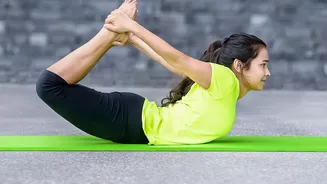








Deconstructing the Hidden Lotus Pose
The pose in question is Baddha Padmasana, often called the Bound or Hidden Lotus Pose. The name itself, derived from Sanskrit, tells the story: 'Baddha' means bound, and 'Padma' means lotus. It begins in the full Lotus Pose (Padmasana), where each foot
is placed on the opposite thigh. From there, the practitioner wraps both arms behind their back, crossing them to grasp the big toe of the opposite foot—right hand to right toe, left hand to left toe. This intricate 'bind' is what makes the pose so challenging. It demands an extraordinary level of flexibility not just in the hips and knees, which are deeply flexed in Lotus, but also profound openness in the shoulders and chest to allow the arms to wrap around the torso successfully. It is considered an advanced posture, suitable only for experienced practitioners who can already sit in the full Lotus Pose comfortably and without any strain.
The Rewards of Advanced Practice
The dedication required to achieve Baddha Padmasana comes with a host of physical and mental benefits. Physically, it provides an intense stretch for the shoulders, arms, back, hips, and knees, promoting flexibility across the entire body. The posture helps open the chest, which can encourage deeper breathing and improve posture, counteracting the slouch that comes from long hours of sitting. The compression on the abdomen is also believed to stimulate digestive organs. Beyond the physical, Baddha Padmasana is a powerful meditative pose. Holding the posture requires immense concentration and body awareness, which helps to calm the mind, reduce stress, and improve focus. For many, it's a pose that symbolises the union of physical effort and mental stillness, a key goal in the practice of yoga.
A Clear Word of Caution
While the benefits are significant, the risks are just as real, especially if the pose is attempted without adequate preparation. This is not a posture to be forced. The primary areas of concern are the knees and hips. Forcing the legs into Lotus can place immense strain on the knee joints, potentially leading to ligament or meniscus tears. Similarly, the deep external rotation required from the hips can cause injury if the joint is not sufficiently open. The shoulder bind also carries risk; an aggressive attempt to grab the toes can strain the rotator cuff muscles. Pain is a clear signal to stop immediately. Attempting advanced poses before your body is ready moves the practice from a mindful, health-giving activity to a high-risk ego-driven exercise. Listening to your body is paramount. This pose should only be attempted under the guidance of a qualified instructor, particularly for those new to it.
Your Path to a Safer Practice
So, how can you work towards such a pose safely? The journey is gradual and focuses on foundational mobility. Before even thinking about Baddha Padmasana, one must be completely comfortable in Padmasana (Lotus Pose). To get there, focus on preparatory poses that open the hips and increase flexibility. Poses like Baddha Konasana (Bound Angle Pose), Janu Sirsasana (Head-to-Knee Forward Bend), and Ardha Padmasana (Half Lotus Pose) are excellent starting points. These asanas gradually increase external hip rotation without putting undue stress on the knees. For the shoulder-opening component, poses like Gomukhasana (Cow Face Pose) are invaluable for increasing the range of motion required for the behind-the-back bind. Using props like straps can also help bridge the gap as you work on flexibility. Remember, the goal in yoga is not to conquer a pose but to understand and honour your body's current abilities.