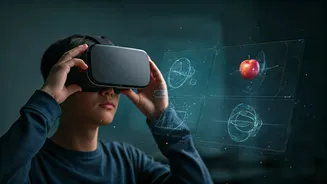









What is a VR Physics Lab?
Imagine stepping into a laboratory where the laws of physics are yours to command. You put on a Virtual Reality (VR) headset and are instantly transported. Instead of a cramped classroom, you see a state-of-the-art facility. You can pick up virtual batteries,
wires, and bulbs to build a complex circuit, or manipulate prisms and lenses to see how light bends. A VR physics lab is a fully interactive, 3D simulated environment that replicates a real-world laboratory. Using handheld controllers, students can conduct experiments, interact with equipment, and visualise abstract concepts like magnetic fields or gravitational waves in a tangible way. It’s not a passive video; it's a hands-on experience where your actions have realistic consequences, all within a digital space.
The 'Risk-Free' Advantage
The most immediate benefit of VR labs is the complete elimination of physical risk. High school physics and chemistry experiments often involve delicate glass equipment, corrosive chemicals, open flames, or high-voltage electricity. In a traditional setting, a single mistake can lead to broken equipment, minor injuries, or worse. In a virtual lab, a student can 'spill' acid or 'short-circuit' a power supply with zero real-world danger. This freedom to fail is a powerful learning tool. When students aren't afraid of making mistakes, they are more likely to experiment, explore, and push the boundaries of their understanding. They can repeat an experiment dozens of time, tweaking variables each time, without consuming any materials or wearing down equipment. This fosters a deeper, more intuitive grasp of scientific principles.
Beyond Safety: Bridging the Access Gap
Perhaps the most revolutionary aspect of VR labs for a country like India is their potential to democratise education. Building and maintaining a modern science laboratory is incredibly expensive. It requires significant investment in infrastructure, equipment, and recurring costs for consumables. As a result, countless schools, particularly in rural and semi-urban areas, have under-equipped or non-existent labs. This creates a massive disparity in educational opportunities. VR classrooms can level the playing field. A school needs only a set of VR headsets and the relevant software to give its students access to a virtual lab that is as good as, or even better than, the best-funded physical lab in the country. This technology allows every student, regardless of their school's budget, to conduct sophisticated experiments that were previously the privilege of a select few.
Aligning with Modern Pedagogy
This shift towards immersive learning aligns perfectly with the goals of India's National Education Policy (NEP) 2020, which strongly advocates for moving away from rote memorisation towards experiential and inquiry-based learning. Physics, in particular, is a subject that is often taught through abstract equations and diagrams, making it difficult for many students to connect with. VR changes this by making the abstract concrete. Instead of reading about projectile motion, students can launch a virtual cannon and see the trajectory change as they adjust the angle and force. This 'learning by doing' approach has been shown to dramatically improve retention, engagement, and conceptual understanding. It transforms students from passive recipients of information into active participants in their own education.
Challenges and the Road Ahead
While the potential is immense, widespread adoption of VR labs is not without its hurdles. The initial cost of VR headsets, while decreasing, can still be a barrier for many institutions. Furthermore, teachers need to be trained not just on how to use the technology, but on how to integrate it effectively into their curriculum. Creating high-quality, scientifically accurate, and pedagogically sound VR content is also a significant undertaking. Indian ed-tech companies are already stepping up to create platforms and content tailored for the Indian curriculum. As the technology matures and costs come down, the key will be a concerted effort from policymakers, educational institutions, and technology providers to build a supportive ecosystem. The journey is just beginning, but the destination—a more equitable, engaging, and effective science education for all—is well worth the effort.