




A New Powerhouse in the Cosmos
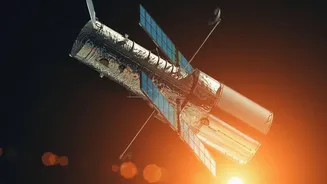
Scheduled for launch by August 30, 2026, the Nancy Grace Roman Space Telescope is NASA's next flagship mission, on par with the Hubble and James Webb Space Telescopes (JWST). Named after NASA's first chief of astronomy, Nancy Grace Roman, the telescope
has a 2.4-meter primary mirror, the same size as Hubble's. However, its primary instrument gives it a colossal advantage. While Roman's main goals include investigating the cosmic mysteries of dark energy and dark matter, its impact on exoplanet science is expected to be revolutionary. The telescope is designed to survey the sky with unprecedented speed and scale, potentially discovering thousands of new planets on its own during its five-year primary mission.
The Power of a Wider Gaze
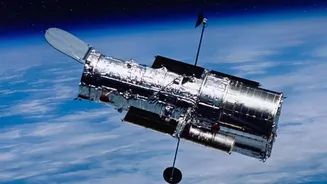
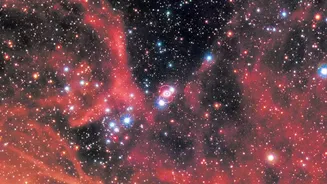
Roman's key advantage is its Wide Field Instrument (WFI), which provides a field of view 100 to 200 times larger than that of Hubble's or Webb's infrared instruments. This panoramic capability means that in a single snapshot, Roman can capture an area of the sky that would require hundreds of individual images from its predecessors. This incredible efficiency allows it to survey vast patches of the Milky Way, increasing the odds of catching the fleeting signals of distant planets. In the time it took Hubble to create its famous Ultra Deep Field image, Roman could capture an image just as deep but covering an area 100 to 200 times larger. This survey power is what will allow it to accelerate the search for exoplanets, building a massive catalogue of new worlds for further study.
A New Trick for Finding Planets
While Roman will use the tried-and-true transit method—watching for dips in starlight as a planet passes in front of its star—its primary planet-hunting technique will be gravitational microlensing. This method relies on a phenomenon predicted by Albert Einstein, where the gravity of a foreground star and its planets can bend and magnify the light of a much more distant, unrelated star that passes behind it. This creates a temporary, sharp spike in the background star's brightness, signaling the presence of the foreground system. Microlensing is particularly effective at finding planets that are harder to detect with the transit method, such as those farther from their star in orbits similar to Earth's or Jupiter's, as well as smaller, rocky worlds and even "rogue" planets that don't orbit a star at all.
Building a Galactic Census
Because microlensing can detect planets with a wide range of masses and orbits, Roman will help create the most comprehensive census of planetary systems in our galaxy to date. Current methods are often biased towards finding large, gaseous planets in tight, close orbits. Roman's microlensing survey, which will stare at the dense star fields in the center of the Milky Way, will be sensitive enough to find analogs to nearly every planet in our own solar system. Scientists anticipate that Roman could find thousands of planets via microlensing and potentially identify up to 100,000 candidates using the transit method, dramatically increasing the number of known exoplanets, which currently stands at around 6,000.
First Steps to Imaging Other Earths
Beyond simply detecting planets, Roman carries an advanced technology demonstrator called the Coronagraph Instrument. A coronagraph works by blocking the overwhelming glare of a host star, allowing the much fainter light reflected by an orbiting planet to be seen directly. Roman's coronagraph will be at least 100 times more powerful than any existing instrument, capable of imaging large, Jupiter-like planets directly. While it is not powerful enough to directly image an Earth-sized planet, it represents a crucial technological step. It will pave the way for future missions, like the planned Habitable Worlds Observatory, that could one day capture the first direct images of a true Earth analog.