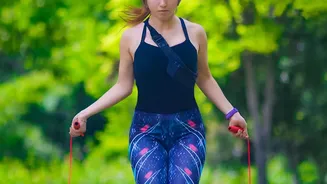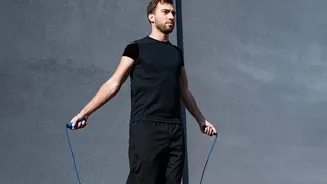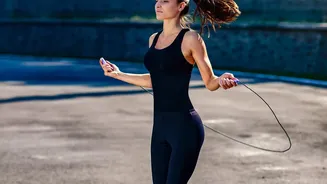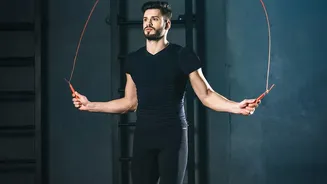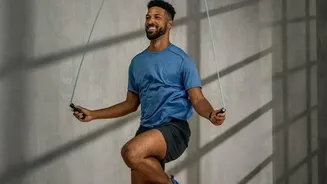






Ready to discover one of the most efficient, affordable, and fun ways to get fit? Jump rope training is a powerhouse workout you can do anywhere. This guide will walk you through everything you need to start with beginner-friendly intervals.
Why Start Jumping Rope?
Before you
take the leap, it's worth knowing why this simple tool is so celebrated in the fitness world. Jumping rope is a fantastic cardiovascular exercise that gets your heart rate up quickly, improving heart health and endurance. It's also a calorie-burning powerhouse, making it an efficient option for weight management when combined with a healthy diet. But the benefits go beyond just cardio. It’s a full-body workout that engages your lower body, core, and even your upper body and shoulders. Furthermore, regular practice can significantly improve your coordination, balance, and agility, skills that are valuable in everyday life and other sports. It's also a weight-bearing exercise that can help build and maintain bone density, which is crucial as we age.
Choosing Your First Rope
Walking into the world of jump ropes can be surprisingly complex, with options ranging in material and weight. For beginners, the best choice is often a beaded rope or a slightly weighted PVC rope. These types provide more 'feedback' as the rope rotates, making it easier to feel the rhythm and learn the timing of your jumps. Speed ropes, which are thin wire cables, are best saved for when you become more advanced, as their lightness can make them difficult to control initially. The most critical factor is length. A rope that's too long will be slow and clumsy, while one that's too short will constantly trip you up. A reliable way to find the right size is to stand on the middle of the rope with both feet. The ends of the handles should reach your armpits. If you're buying an adjustable rope, it's better to start a little longer and shorten it as your form improves.
Mastering the Basic Form
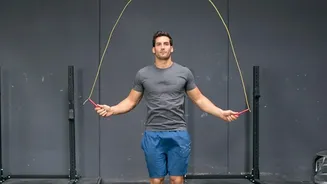
Good form is the foundation of effective and injury-free jump rope training. Before you even start swinging, practice your bounce. Stand with your feet together and perform small, consistent hops on the balls of your feet, keeping your heels from stomping on the ground. Your jumps should be low, only about an inch or two off the ground—just high enough to clear the rope. Maintain an upright posture with your chest up, shoulders back and relaxed, and your eyes looking forward. Your arms should do very little work. Keep your elbows tucked near your ribs and your hands positioned slightly in front of your hips. The rotation should come from your wrists, not from big, sweeping arm circles. Practice swinging the rope to the side of your body with one hand to get a feel for this wrist-driven motion.
Your First Interval Workout
Interval training is a fantastic way for beginners to build endurance without getting overwhelmed. The structure involves alternating between periods of work (jumping) and periods of rest. This method allows you to push yourself in short bursts and recover, which is highly effective for improving cardiovascular fitness. A great starting point is to have a longer rest period than your work period. This gives your body ample time to recover for the next set. Here is a simple, effective workout to begin with. Perform a light warm_up of leg swings, arm circles, and light jogging in place for 3–5 minutes before you start. The Workout: 30 seconds of jumping followed by 60 seconds of complete rest (or walking in place). Repeat this cycle 5 to 8 times. As you get more comfortable over several sessions, you can begin to adjust the intervals by increasing your jump time or decreasing your rest time. For example, you might move to 45 seconds of jumping with 45 seconds of rest.
Two Fundamental Moves to Learn
You don't need fancy tricks to get a great workout. Mastering two basic moves will provide a solid foundation for your training. The first is the Bounce Step, also known as the basic jump. With your feet together, you perform one jump for every revolution of the rope. Focus on maintaining a steady rhythm and low, controlled bounces. The second essential move is the Alternate–Foot Step. As the name implies, you'll alternate landing on one foot at a time, similar to running in place. This movement is great for developing coordination and allows you to jump for longer periods as it distributes the effort between your legs. Once you are comfortable with both, you can alternate between them during your workout intervals to add variety.