



A Solar System in Miniature
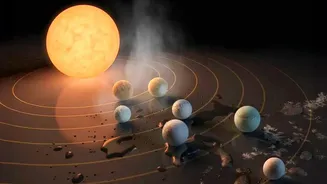
When astronomers discovered the TRAPPIST-1 system, the excitement was palpable. Here was a compact family of seven rocky planets, all roughly the size of Earth, orbiting a small, cool red dwarf star. Three of these worlds—TRAPPIST-1e, f, and g—were located
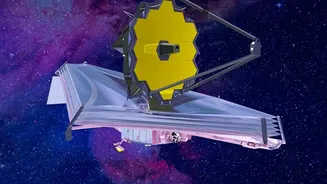
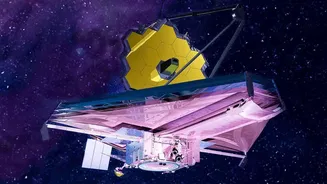
in the star's 'habitable zone', the temperate region where liquid water could potentially exist on a planet's surface. This made the system a prime target for follow-up studies. Initial observations with the Hubble Space Telescope had already ruled out bulky, Neptune-like hydrogen atmospheres, leaving the door open for denser, more Earth-like ones. The stage was set for the powerful James Webb Space Telescope (JWST) to peer closer and tell us if these worlds were truly havens for life.
Webb's Unblinking Gaze Delivers a Surprise
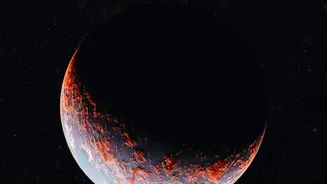
As JWST turned its advanced instruments towards the inner planets, the optimistic narrative began to crumble. By measuring the heat emitted from the planets, astronomers got their first real look at their climates. The results for TRAPPIST-1b and TRAPPIST-1c, the two innermost planets, were stark. The data showed blistering hot daysides and frigid nights, with no significant heat being redistributed from one side to the other. This is a tell-tale sign of a planet with little to no atmosphere. The findings suggest these worlds are likely bare rocks, scoured clean of any substantial gaseous envelope. This was the first major blow to the idea that planets in this system could easily hold onto their atmospheres.
A Violent Youth Changes Everything
The lack of air around the inner TRAPPIST-1 planets forced a major rethink of their evolutionary history. The culprit? The system's own star. Red dwarfs like TRAPPIST-1 are notoriously volatile in their youth, unleashing intense radiation and powerful stellar winds. The initial thinking was that some planets might be able to withstand this onslaught. However, the JWST findings suggest the star's early activity was far more destructive than many models had predicted, effectively stripping the primordial atmospheres from the planets closest to it. This reshapes our understanding of how planetary systems around the most common type of star in our galaxy evolve. It implies that a planet’s formation story isn't just about its location, but about surviving the violent tantrums of its young parent star.
What About the Habitable Zone?
With the inner planets appearing to be airless, all eyes turned to the worlds in the habitable zone. Observations of TRAPPIST-1d, which sits on the inner edge of this zone, also came back negative for a thick, Earth-like atmosphere. The focus then shifted to TRAPPIST-1e, another Earth-sized world orbiting squarely in the habitable zone. The data here is more ambiguous. While a thick hydrogen or carbon-dioxide-dominated atmosphere has been ruled out, there's a slim possibility of a thinner, secondary atmosphere—one that might have formed later from volcanic outgassing. However, the data is also consistent with TRAPPIST-1e being a bare rock, just like its siblings. Disentangling the faint signal of a potential atmosphere from the noise of the active star is proving to be a monumental challenge for scientists.
Refining the Search for Other Earths
The TRAPPIST-1 findings do not mean the search for life around red dwarfs is over. Instead, they provide crucial, sobering context. The story of this system's evolution from a place of high hopes to one of atmospheric absence is a lesson in planetary science. It highlights that the habitable zone is not a magic circle guaranteeing clement conditions. A planet's ability to form and retain an atmosphere is a complex battle against the physics of its own star. The lessons learned from TRAPPIST-1 are now being applied to JWST’s observations of other red dwarf systems, helping astronomers refine their models and better select targets that might have had a less violent past. All hope is not lost, but the search for another Earth has become more nuanced.