

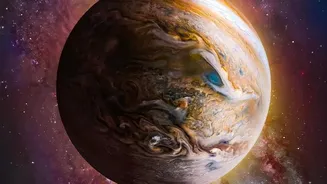
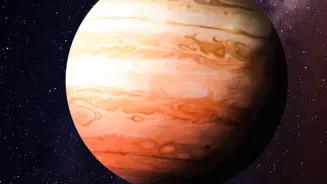
Cosmic Tornados or Giant Cyclones?
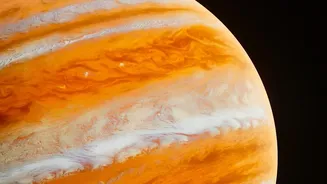
First, let's clarify what these 'cosmic tornados' really are. The term is a dramatic way to describe the massive cyclones and anticyclones churning through Jupiter's atmosphere. Unlike Earth's tornadoes, which are small, brief, and violent funnels, Jupiter's storms
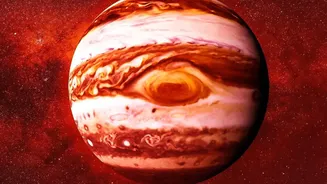
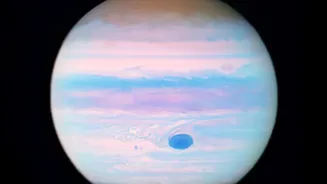
are vast, high-pressure or low-pressure systems that can be hundreds, or even thousands, of kilometres across. Some of these, like the famous Great Red Spot, have been raging for centuries. The new data focuses on different, though equally fascinating, storm systems: the clusters of cyclones that perpetually circle Jupiter's north and south poles. These storms are arranged in stunningly geometric patterns, with a central cyclone surrounded by others in a near-perfect polygon, a phenomenon unseen anywhere else in our solar system.
A Shrinking Phenomenon
For decades, scientists have known that the Great Red Spot is getting smaller. It has been steadily contracting for at least a century, shrinking from a size that could swallow three Earths to being just wider than our own planet today. But the latest analysis, using data gathered by NASA's Juno spacecraft, suggests this shrinking phenomenon is not unique to the Great Red Spot. The new research points to changes in the size and intensity of the polar cyclones. By comparing images from Juno's repeated close flybys, scientists can track the evolution of these storms, noting changes in their size, shape, and wind speed. While some storms remain stable, others show clear signs of weakening and shrinking.
The Science of a Fading Storm
So, why would a storm that has lasted for years or decades begin to shrink? The answer lies in a delicate and complex balance of energy. Planetary scientists believe these gigantic vortices sustain themselves by drawing energy from the planet's atmosphere or by consuming smaller, nearby storms. One prominent theory for the Great Red Spot's shrinkage is that it is essentially 'starving'. A decrease in the number of smaller storms it can absorb means it has less energy to maintain its colossal size. A similar process may be at play with the polar cyclones. These storms are in a constant, slow-motion dance, and if the atmospheric dynamics shift, a storm can lose energy faster than it can acquire it. This could happen through interactions with Jupiter's powerful jet streams or by shedding smaller vortices of its own, a process that bleeds away its rotational energy over time.
Juno's Ringside Seat
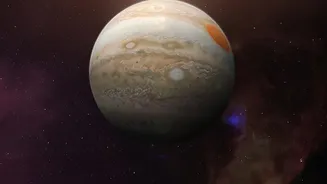
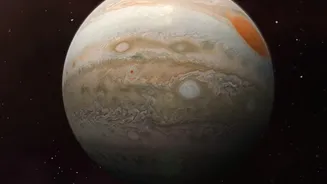
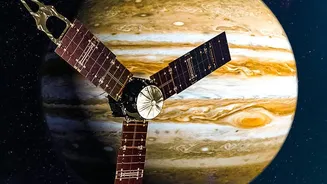
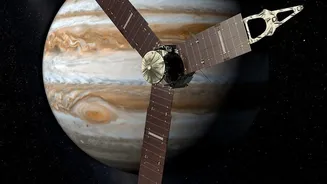
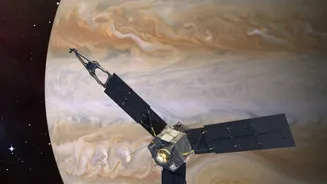
These discoveries would be impossible without NASA's Juno mission. Launched in 2011, Juno arrived at Jupiter in 2016 and has been orbiting the gas giant ever since, swooping in for close passes over its poles. Its suite of instruments, especially the JunoCam, provides unprecedented views of the planet's turbulent cloud tops. Juno's highly elliptical orbit is specifically designed to study the polar regions, which are difficult to observe from Earth. The raw data from JunoCam is even made available to the public, allowing citizen scientists to process the images, often revealing stunning details that help researchers better understand Jupiter's chaotic weather.
Why Jupiter's Weather Matters
Studying the birth, life, and death of storms on Jupiter does more than just satisfy our curiosity about a distant planet. Jupiter is a laboratory for extreme weather, and understanding its atmospheric dynamics helps scientists refine their models of how planetary atmospheres work in general. The forces that shape Jupiter's storms are similar to those that create weather systems on Earth, just on a much grander and longer-lasting scale. By figuring out what makes these giant vortices tick—and what causes them to fade—we gain crucial insights into the fundamental physics of fluid dynamics that govern everything from ocean currents on our own world to the atmospheres of giant exoplanets being discovered around other stars.