







A Groundbreaking 'Thermometer'
At the heart of this discovery is the Chandra’s Surface Thermophysical Experiment, or ChaSTE. Think of it as a highly sophisticated thermometer designed for the Moon. Developed by the Indian Space Research Organisation (ISRO) in collaboration with the Physical
Research Laboratory (PRL), ChaSTE is a probe that can penetrate up to 10 centimetres into the lunar regolith—the correct term for the Moon's crushed rock and dust. Its primary mission was to measure the temperature profile of the topsoil near the lunar south pole, a region never before studied with in-situ instruments. This data is crucial for understanding how the Moon's surface behaves thermally, absorbing heat during its long day and cooling down during its equally long night.
Not Dust, but a 'Layer Cake'
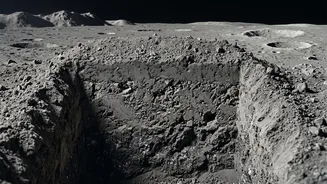
For decades, scientists largely assumed the Moon's topsoil, or regolith, was a relatively uniform mixture churned by billions of years of micrometeorite impacts. However, the data sent back by ChaSTE paints a very different picture. Instead of a single, consistent layer, the instrument found a layered, 'cake-like' structure just within the top few centimetres. A recent study based on ChaSTE's initial measurements identified three distinct layers within the top 10 cm, each with different properties. The very top layer, down to about 3 cm, is extremely porous and fluffy, acting like a superb thermal blanket. Beneath this, the regolith becomes progressively denser and more cohesive, or 'sticky'.
From Fluffy Flour to Stiff Clay
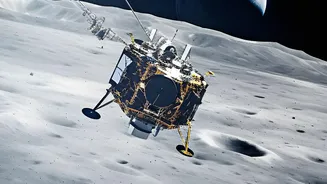
The differences are striking. Data shows that the bulk density of the regolith more than doubles from the surface to a depth of just 6.5 cm, increasing from about 750 kg per cubic metre to around 1600 kg per cubic metre. Scientists at ISRO explained the contrast in practical terms: for an astronaut, walking on the surface might feel like treading on dry flour. But just a few inches deeper, the material would behave more like damp, stiff clay. This unexpected variability was further confirmed by an ingenious 'hop' experiment, where the Vikram lander fired its engines to lift off and land about 50 cm away. This action blew away the top layer of loose dust, exposing the denser material underneath and allowing ChaSTE to take a second set of measurements that confirmed the layered structure.
Why This Finding Is a Game-Changer
This discovery is about more than just lunar geology; it has profound implications for the future of Moon exploration. The properties of the regolith are a critical factor in planning any long-term presence on the Moon. For one, the highly insulating nature of the top layer could be vital for protecting subsurface water ice from sublimating away in the harsh lunar environment. Understanding this layered structure is also essential for designing and building future lunar habitats and infrastructure. Knowing that the ground becomes significantly more stable and compact just a few centimetres down provides crucial information for engineers planning to construct bases or landing pads. The abrasive and sticky nature of this dust was a major problem for Apollo astronauts, damaging spacesuits and equipment, and this new data will help develop better mitigation strategies.
The Continuing Legacy of Chandrayaan-3
Even months after its historic landing, Chandrayaan-3 continues to deliver groundbreaking science. These findings from ChaSTE represent the first-ever direct, on-site measurements of the thermal and physical properties of the lunar soil at the south pole. Previous data came from equatorial regions during the Apollo missions or from remote-sensing orbiters. This detailed ground-truth information provides a vital reference point that will help scientists interpret orbiter data for other locations and better select sites for future missions. The discovery that the lunar surface is not uniform, even over very short distances, highlights how much more there is to learn about our nearest celestial neighbour.