



Sailing on a River of Light
At its heart, a solar sail works much like a sailboat on water, but with a crucial difference: its 'wind' is sunlight. A solar sail is a massive, mirror-like sheet deployed from a spacecraft. Instead of catching wind, it captures the constant stream of light particles,
or photons, radiating from the Sun. This revolutionary concept eliminates the need for heavy, expensive, and finite chemical propellants, offering a new way to travel vast cosmic distances. The idea itself has been around for over a century, but only in recent decades have missions like Japan's IKAROS and The Planetary Society's LightSail 2 successfully demonstrated its potential in space.
The Gentle Push of a Photon
How can light, which has no mass, push a spacecraft? The answer lies in momentum. Although individual photons are massless, they carry momentum as they travel through space. When these countless photons strike the highly reflective surface of a solar sail, they bounce off, transferring their momentum to the sail in the process. This transfer imparts a tiny but continuous push. While the force from a single photon is infinitesimally small, the unceasing torrent of photons from the Sun adds up. In the frictionless vacuum of space, this gentle, persistent pressure is enough to steadily accelerate the spacecraft. It is the light pressure from photons, not the solar wind, that provides the thrust.
A Marathon, Not a Sprint
Conventional rockets provide immense thrust for a short period, a powerful shove that quickly burns through fuel before the spacecraft coasts for most of its journey. Solar sails operate on the opposite principle. They provide very low thrust, but they do so constantly, for as long as the sail is exposed to sunlight. This steady, unending acceleration allows a solar sail-powered vehicle to build up incredible speeds over time. While a chemical rocket is faster off the line, a solar sail spacecraft can eventually overtake it, reaching velocities that would be impractical or impossible for missions relying solely on propellant. This makes them ideal for long-duration, deep-space missions.
Designing the Perfect Sail
For a solar sail to work, it must be two things: enormous and incredibly light. The larger the surface area, the more photons it can catch, increasing the thrust. The lower the total mass of the spacecraft, the greater the acceleration from that thrust. This has led to the development of gossamer-thin materials, such as Mylar or Polyimide, coated with a microscopically thin layer of reflective aluminum. The LightSail 2 mission, for instance, used sails that were just 4.5 microns thick—thinner than a human hair. The engineering challenge is not just the material, but also developing complex mechanisms to unfold these vast, delicate structures from a compact satellite and control their orientation in space to 'steer' the craft.
Putting the Technology to the Test
Several missions have successfully proven the viability of solar sailing. Japan's IKAROS probe, launched in 2010, was the first to demonstrate solar sailing in interplanetary space. More recently, The Planetary Society's crowdfunded LightSail 2, launched in 2019, successfully used a solar sail to raise its orbit around Earth, providing definitive proof of controlled solar sailing for small satellites. NASA is also advancing the technology with missions like the Advanced Composite Solar Sail System (ACS3), launched in 2024 to test new, lightweight carbon fiber booms that could enable even larger and more powerful sails for future missions.
The Future of Interstellar Travel
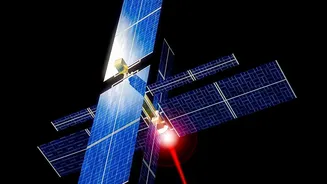
The potential of solar sails extends beyond our own solar system. While sunlight becomes too weak for propulsion in interstellar space, the same principle could be applied using powerful, Earth-based lasers. A laser beam could be focused on a sail, pushing a small probe to a significant fraction of the speed of light. Projects like Breakthrough Starshot aim to develop this very concept to send a fleet of tiny, sail-powered nanocraft to our nearest star system, Alpha Centauri. While many challenges remain, solar sailing represents one of the most promising technologies for humanity's first steps into the interstellar ocean.