



A Breakthrough Discovery in a Gas Cloud
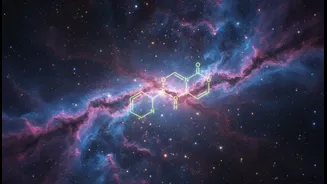
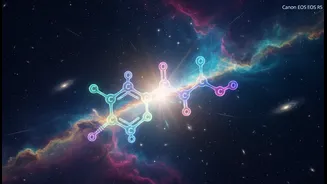
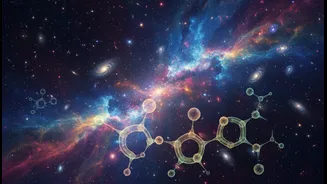
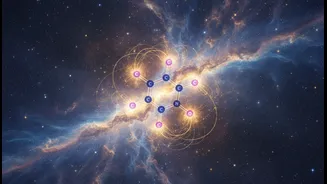
In a major leap for astrobiology, an international team of scientists has announced the first-ever direct detection of a true sugar molecule in the interstellar medium—the vast, thin expanse of gas and dust between stars. The molecule in question is erythrulose,
a four-carbon sugar. To bring this cosmic finding down to Earth, erythrulose is a compound that occurs naturally in red raspberries and is even used in some self-tanning products. The discovery, published in the journal Nature Astronomy on July 13, 2026, places this complex organic molecule in a molecular cloud known as G+0.693-0.027, located near the turbulent center of our own Milky Way galaxy, some 26,700 light-years away.
How to Find a Sugar Molecule in Space
You can't exactly scoop a sample from a gas cloud light-years away. Instead, astronomers used powerful radio telescopes in Spain—the Yebes 40-meter and IRAM 30-meter telescopes—to listen for molecular 'fingerprints'. Every molecule vibrates and rotates, emitting faint radio signals at very specific frequencies. The team carefully analyzed the signals coming from the gas cloud and detected 12 sets of emissions that perfectly matched the unique spectral signature of erythrulose measured in a laboratory. This painstaking process allowed them to confirm, with high confidence, the presence of gaseous erythrulose floating in a stellar nursery, long before planets have even begun to form.
Why This Is a Prebiotic Game-Changer
Finding sugar in space is exciting, but its true importance lies in what it means for the origin of life. Sugars are essential biological molecules, forming the backbone of RNA and DNA and fueling our cells. For years, scientists have wondered how the first sugars formed on a primitive Earth, as lab experiments simulating those conditions often produce them in very low quantities. The discovery of erythrulose in space provides a powerful answer: perhaps the ingredients weren't made here, but delivered. While erythrulose itself isn't a direct part of our DNA, in watery environments it can transform into threose, a key component of Threose Nucleic Acid (TNA), which some scientists believe was an evolutionary predecessor to RNA. This makes erythrulose a highly relevant prebiotic molecule.
Rewriting the Cosmic Cookbook
The finding has also challenged long-held theories about how complex molecules form in space. The prevailing view was that they grow incrementally, with smaller molecules adding one carbon atom at a time. But the scientists were stunned to find that erythrulose, a four-carbon sugar, was at least eight times more abundant than any simpler three-carbon sugars, which were not detected at all. This suggests a different recipe. The team's models indicate that erythrulose likely forms more efficiently on the icy surfaces of interstellar dust grains, perhaps by combining two-carbon molecules. It's a significant shift in our understanding of cosmic chemistry.
From the Stars to Early Earth
This discovery bolsters the hypothesis that the raw materials for life on Earth came from space. The idea is that comets and meteorites, which are formed from this same interstellar dust and gas, bombarded the young Earth and delivered a chemical starter-pack. Based on its abundance in the cloud, researchers estimate that millions of tonnes of erythrulose could have arrived on our planet during the Late Heavy Bombardment period billions of years ago. This cosmic delivery could have provided a rich feedstock for the prebiotic synthesis of the first nucleic acids, kickstarting the journey toward life. It suggests the chemical ingredients for life may be common throughout the galaxy.