




First, Let’s Define Our Terms
Before we dive into Venus’s peculiarities, let's clarify what we mean by a ‘day’ and a ‘year’. A year is straightforward: it’s the time it takes for a planet to complete one full orbit around its star. For Earth, that’s roughly 365 days. A day, however,
refers to a planet's rotational period—the time it takes to spin once on its axis. On Earth, this is about 24 hours. We intuitively expect a year to be made up of many, many days. It’s a rhythm that defines life on our world. But the solar system is full of exceptions, and Venus is perhaps the most mind-bending of them all.
Venus by the Numbers
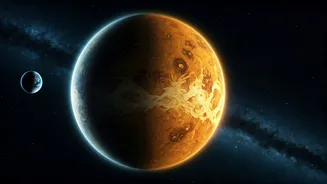
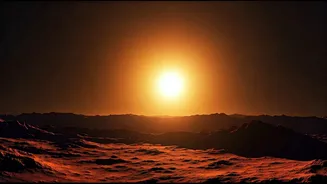
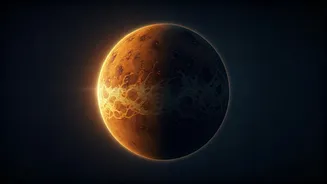
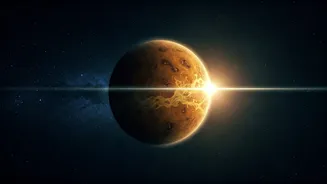
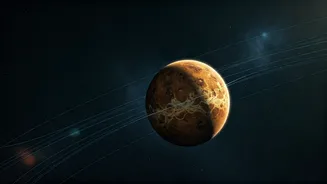
Here is where our Earth-based intuition gets thrown out the window. A year on Venus—one trip around the Sun—takes about 225 Earth days. Now for the shocker: a single day on Venus—one full rotation on its axis—takes approximately 243 Earth days. Let that sink in. It takes longer for Venus to spin once than it does for it to complete its entire annual journey. If you could stand on Venus (which you can’t, given the crushing pressure and lead-melting temperatures), you would see the Sun rise and set just twice over the course of a single Venusian year. The day is, quite literally, longer than the year.
Spinning the Wrong Way
As if that wasn't strange enough, Venus also spins backward. Nearly every other planet in our solar system, including Earth, rotates on its axis in a counter-clockwise direction (prograde motion). This means the Sun appears to rise in the east and set in the west. On Venus, it’s the opposite. The planet has a retrograde, or clockwise, rotation. An observer on its surface would see the Sun rise in the west and set in the east. This backward, lethargic spin is a giant clue that something dramatic happened in Venus’s past or is happening in its present.
The Power of a Thick Atmosphere
So why is Venus so slow and backward? The leading theory points to its hellishly thick atmosphere. The atmosphere of Venus is 90 times denser than Earth’s, composed almost entirely of carbon dioxide. This creates an immense greenhouse effect and, crucially, powerful atmospheric tides. The Sun's gravity pulls on the planet, but its intense heat also creates thermal bulges in the dense atmosphere. According to models, the friction between this thick, sloshing atmosphere and the solid planet below has acted as a powerful brake over billions of years, slowing Venus’s rotation to its current crawl.
An Ancient Cosmic Collision?
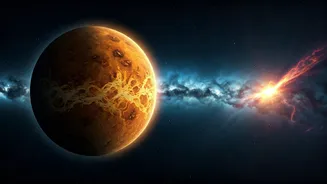
Another compelling theory, which may work in tandem with the atmospheric drag model, involves a catastrophic past. Some planetary scientists believe that early in its history, Venus may have been struck by a massive asteroid or planetesimal. A powerful enough impact, hitting at just the right angle, could have dramatically altered its spin, either slowing it down to near zero or even flipping it over, causing its rotation to appear retrograde. It’s possible that an ancient collision set Venus on its slow, backward path, and the thick atmosphere has helped maintain that state ever since.
A World Without a Strong Pulse
This incredibly slow rotation has profound consequences. Earth’s relatively fast spin helps generate its protective magnetic field, which shields us from harmful solar radiation. Venus’s slow spin means it cannot generate a similar dynamo effect in its core, leaving it without a significant global magnetic field. Its sluggish turn also contributes to its extreme climate; with such long days and nights, the sun-facing side bakes for months while the night side cools, though the thick atmosphere does an efficient job of distributing that heat across the entire planet, maintaining scorching temperatures everywhere.