



From Data Points to Musical Notes
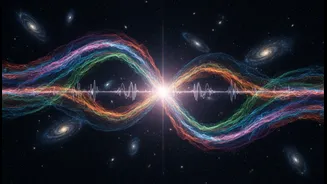
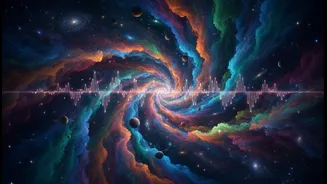
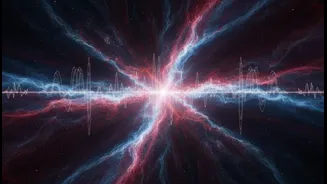
First, let's clear up a common misconception: these are not sounds recorded by a microphone in space. Since space is overwhelmingly a vacuum, sound waves have no medium to travel through. Instead, scientists are using a process called data sonification.
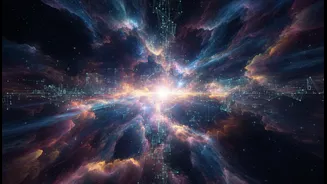
This technique translates information—the same digital data used to create stunning images from telescopes like Hubble and Chandra—into sound. Think of it as a form of translation. Just as raw data can be mapped to pixels to create a picture, it can also be mapped to musical properties. For example, the brightness of a star could determine the volume of a note, its colour could dictate the pitch (higher frequency light becomes a higher note), and its position in an image could correspond to when it's heard in the composition. A computer then scans the image, playing the 'score' from left to right or from the centre outwards, turning a static image into a dynamic auditory experience.
A New Frontier for Scientific Discovery
While sonification is a fantastic tool for public engagement, its primary purpose is often scientific. The human ear is exceptionally good at detecting patterns, sometimes even better than the eye. By listening to data, researchers can perceive subtle changes, trends, and anomalies that might be missed in a purely visual analysis. This is especially useful when dealing with massive, complex datasets from deep-space observations. For example, an astronomer might 'hear' the tell-tale dip in a star's light curve that indicates a planet passing in front of it. Furthermore, sonification is revolutionising accessibility in STEM fields. It provides a powerful pathway for blind and visually impaired scientists to analyse data and make discoveries, creating a more equitable and inclusive environment for research.
The Orchestra of the Cosmos
NASA's Chandra X-ray Observatory has been a pioneer in this field, creating an extensive library of sonified cosmic objects since launching a dedicated program in 2020. They’ve given an audio identity to everything from the chaotic heart of our own Milky Way galaxy to the ethereal Pillars of Creation. Each sonification is a collaboration between scientists, musicians, and sound engineers. In the sonification of spiral galaxy M74, for instance, X-ray data from Chandra are heard as high, glassy notes, while infrared data from the James Webb Space Telescope are represented by deeper tones, creating a multi-layered cosmic symphony. Sometimes, the source is even real sound waves, just not in a range humans can hear. The sonification of the Perseus galaxy cluster is based on actual pressure waves from a supermassive black hole, scaled up by an astounding 57 octaves to become audible.
Making the Universe Go Viral
Beyond the lab, sonification serves a vital role in science communication. The hauntingly beautiful sounds of distant nebulae and colliding galaxies have a unique ability to capture the public imagination. These audio clips are shareable, engaging, and emotionally resonant in a way that dense charts and graphs often are not. They make abstract cosmic phenomena feel more immediate and personal. By transforming science into an art form, these projects are making the universe more 'tap-worthy' for a new generation of digital explorers. They spark curiosity and invite people who might otherwise feel intimidated by science to experience the wonder of discovery. This effort turns passive observation into active listening, allowing anyone with a phone or computer to explore the cosmos in a completely new dimension.