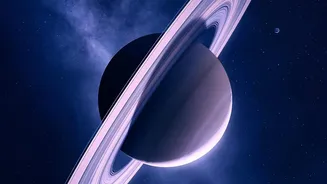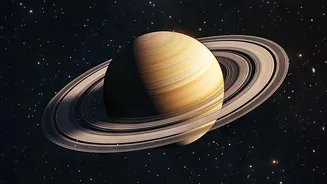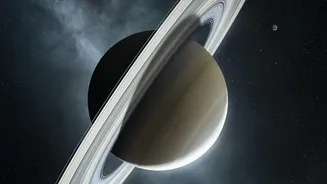




A Surprise Ten-Sided Sibling
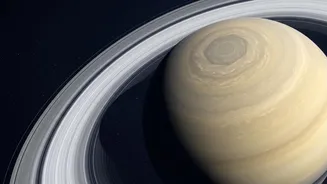
While Saturn's north pole is famed for its giant hexagon, a six-sided jet stream pattern that has been stable for over 40 years, its southern pole was thought to be comparatively plain. That assumption was shattered by the recent discovery of a massive,
ten-sided atmospheric wave, or decagon, encircling the south pole. Announced in September 2026, this is the first large, regular-sided geometric pattern ever confirmed in Saturn's southern hemisphere. The discovery, made using images from the Hubble Space Telescope, proves that the iconic northern hexagon is not the planetary anomaly scientists once thought it was, suggesting that the conditions on Saturn are ripe for forming these strange polygonal shapes at both ends of the planet.
It Formed While We Weren't Looking
One of the most stunning aspects of this discovery is just how new the decagon is. NASA's Cassini spacecraft orbited Saturn for 13 years, from 2004 to 2017, and extensively mapped the south pole. During that entire time, it saw no evidence of a persistent polygonal storm. Scientists were able to trace the decagon's origins using archived Hubble data, finding the first faint hints of the structure appearing in 2023 before it sharpened into a clear ten-sided shape in observations from 2025. This means the entire continent-sized weather system formed sometime after Cassini's mission ended. Unlike the long-stable northern hexagon, the southern decagon is still evolving and strengthening, giving scientists an unprecedented, real-time view of how such a colossal planetary feature comes into being.
Not a Storm, But a Giant Wave
Though it might look like a giant hurricane, the decagon isn't a storm in the earthly sense. Instead, it is what scientists call a massive atmospheric wave embedded within one of Saturn's powerful jet streams. This isn't just a pattern in the top layer of clouds; observations show the wave extends deep into Saturn's atmosphere, indicating it is a significant, vertically stacked structure. The winds associated with this jet stream are ferocious, reaching speeds of around 400 kilometres per hour. The feature is a testament to the immense energy churning within the gas giant's atmosphere, powerful enough to bend fast-moving currents into a stable, geometric shape.
It Behaves Differently Than the Hexagon
Having a polygon at both poles gives scientists a fantastic opportunity for comparison, and the differences are just as revealing as the similarities. Saturn's northern hexagon is famously stationary, remaining locked in place relative to the planet's rotation. The new southern decagon, however, is on the move. It slowly drifts eastward at a speed of about 10 kilometres per hour. Furthermore, the northern hexagon sits closer to its pole than the southern decagon does. These distinctions suggest that while both poles can generate geometric storms, the underlying atmospheric dynamics are not identical. Studying these differences will help researchers refine their models of what drives weather on gas giants.
A Cosmic Neighbour May Be the Sculptor
So, what could create a ten-sided wave that wasn't there just a few years ago? Scientists have a prime suspect. Just north of the decagon, researchers have identified a large, 4,000-kilometre-wide anticyclone—a high-pressure vortex sometimes called a 'Red Spot' in a nod to Jupiter's famous storm. Intriguingly, the decagon's sides appear most sharply defined on the side closest to this vortex. This has led to the theory that the anticyclone may be acting as a 'sculptor,' with its powerful rotation disturbing the main jet stream and helping to generate and sustain the ten-sided wave. It's a crucial clue in the ongoing mystery of the decagon's formation.