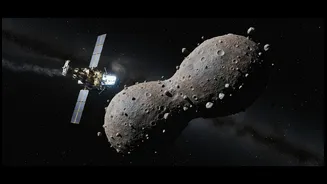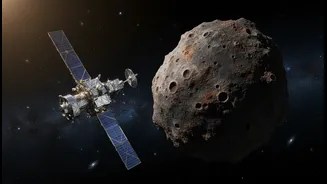




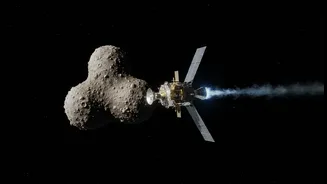
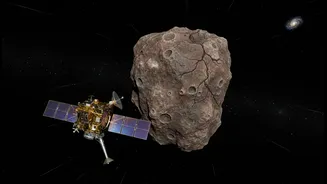
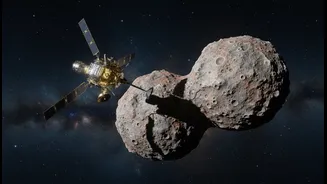


A High-Speed Rendezvous
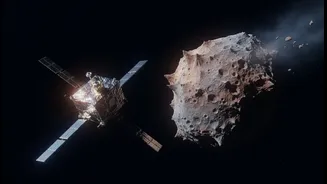
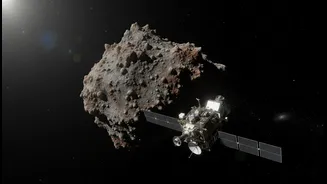
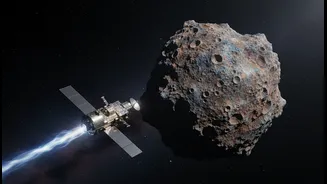
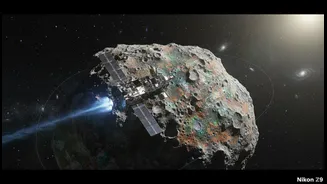
On July 5, 2026, Japan's Hayabusa2 spacecraft executed a daring high-speed flyby of a near-Earth asteroid known as (98943) Torifune. Travelling at a blistering relative speed of about 5 kilometres per second, or 18,000 kilometres per hour, the probe had
only a brief window to perform its observations. This was not a landing or an orbital mission, but a swift pass designed to test the limits of the spacecraft's instruments and the ingenuity of its controllers on the ground. The manoeuvre was technically challenging as Hayabusa2 was not originally built for this kind of high-velocity encounter, requiring it to get as close as possible without colliding to gather meaningful data. The event marked the first major objective of the probe's extended mission, a new chapter in its already historic journey.
An Encore for a Legendary Probe
Hayabusa2 is no stranger to making history. The probe, built and operated by the Japan Aerospace Exploration Agency (JAXA), successfully completed its primary mission in 2020 after a remarkable visit to asteroid Ryugu. Over a year and a half, it mapped the asteroid, deployed tiny hopping rovers, and fired a projectile to create an artificial crater, allowing it to collect pristine subsurface samples. These samples, containing organic molecules and water-bearing minerals, were successfully returned to Earth, offering unprecedented insights into the building blocks of our solar system. Instead of retiring, the healthy spacecraft was given a new lease on life, using its remaining fuel for an extended mission, now officially nicknamed Hayabusa2#. The Torifune flyby is its first stop on a new decade-long journey that will eventually take it to a second asteroid, 1998 KY26, in 2031.
Navigation on a Knife's Edge
The flyby was a masterclass in precision navigation. The headline's reference to "everyday decisions" hints at the intense, minute-by-minute choices required by the mission's engineers. Because Torifune is small and dark, its exact orbit had uncertainties, meaning the team could only finalize the probe's trajectory a few days before the encounter. This required a series of last-minute navigational adjustments to guide the spacecraft to its target. JAXA officials described the feat as being akin to hitting a one-yen coin in Hokkaido from Okinawa. The team's goal was to pass as close as possible—potentially within just a few hundred metres—to a 450-metre-wide object from 100 million kilometres away. This success demonstrates a crucial capability: the ability to precisely guide a spacecraft to a small, fast-moving celestial body.
A New Kind of Asteroid Science
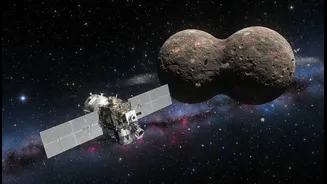
Beyond the technical achievement, the flyby yielded important scientific results. While Ryugu was a carbon-rich C-type asteroid, Torifune is a stony S-type. Studying different types of asteroids helps scientists understand the diversity of materials that formed the planets and provides a more complete picture of our solar system's evolution. Images captured by Hayabusa2's cameras revealed Torifune to be an elongated, two-lobed object, confirming ground-based observations that it was a 'contact binary'—likely two separate asteroids that gently merged into one. By collecting data on its shape, surface, and temperature, Hayabusa2 provides a close-up look at the second most common type of asteroid in our solar system, offering valuable comparative data to its findings at Ryugu.
A Rehearsal for Planetary Defence
Perhaps the most critical aspect of this mission is its role in planetary defence. While Torifune poses no threat to Earth, the skills tested during its flyby are directly applicable to identifying and potentially deflecting a genuinely hazardous asteroid. In a real planetary defence scenario, scientists would need to quickly assess a threat's size, composition, and trajectory. This mission served as a vital dress rehearsal, proving that Japan has the technology to accurately guide a probe to a small target for reconnaissance. This capability is a crucial precursor to kinetic impactor missions, like NASA's DART test in 2022, where a spacecraft is deliberately crashed into an asteroid to alter its course. The Torifune flyby effectively demonstrates that JAXA has developed a key technology needed to help protect our planet from future impacts.