







The Annual Pothole Plague
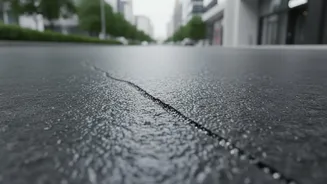
Every year, as the rains arrive, roads across India begin to crumble. What start as tiny cracks quickly become cavernous potholes, causing traffic snarls, vehicle damage, and accidents. Municipal corporations spend crores annually on a seemingly endless
cycle of repairs, often using hot-mix asphalt patches that are a temporary fix at best. These repairs are not only costly but also disruptive and environmentally taxing. The constant need for maintenance means more traffic diversions, more labour, and a significant carbon footprint from the production and transport of repair materials. For citizens, it has become a frustrating and accepted part of life during the monsoon, but engineers are now looking at a solution inspired by nature itself.
What is Self-Healing Concrete?
Imagine a road that, when it cracks, simply repairs itself. This is the promise of self-healing concrete, an innovative construction material that is moving from the laboratory to real-world trials. The concept isn't entirely new; researchers point to ancient Roman concrete, which contained lime clasts that could dissolve and recrystallise to seal cracks, as an early form of this technology. Modern self-healing concrete takes this idea a step further by embedding 'healing agents' directly into the mix. The most promising of these for road applications is bio-concrete, which uses dormant bacteria to act as microscopic construction workers.
How Bacteria Repair the Roads
The science behind bio-concrete is both elegant and effective. During the mixing process, spores of specific, hardy bacteria—often from the Bacillus family—are added to the concrete along with tiny capsules of their food source, typically calcium lactate. These bacteria are chosen for their ability to survive in the highly alkaline environment of concrete and can remain dormant for decades. When a crack forms in the road, rainwater seeps in. This is the trigger. The water awakens the dormant bacteria, which then begin to feed on the nutrients. As they metabolize their food, they produce calcium carbonate—essentially limestone—as a waste product. This limestone deposit grows and hardens, filling the crack from the inside out, sealing it against further water ingress and protecting the steel reinforcement within from corrosion. Once the crack is filled and the area dries out, the bacteria become dormant again, ready for the next time they are needed.
The Road Ahead: Promise vs. Practicality
The potential benefits are enormous. By autonomously repairing microcracks before they become major potholes, self-healing concrete could dramatically extend the lifespan of roads, bridges, and tunnels by decades, or even centuries in some applications. This would lead to a significant reduction in lifelong maintenance costs, with some estimates suggesting savings of up to 50% over the structure's life. Furthermore, it promotes sustainability by reducing the need for new cement production, which accounts for a significant percentage of global CO2 emissions. However, challenges remain before this becomes a standard material. The initial cost of bacterial concrete is higher than traditional mixes, estimated at around 10-30% more. Expertise in handling and implementing the material is still limited, and there is a need for standardized guidelines for its use in different climates and traffic conditions, a key consideration for India's diverse environments.
Is This India's Pothole Solution?
While large-scale city-wide adoption is still on the horizon, the push for this technology in India is growing. Research institutions like the National Institute of Technology (NIT) and CSIR labs are actively working on developing and optimizing bio-concrete using locally available resources. The focus is on making it a cost-effective and practical solution for Indian conditions, particularly the heavy monsoon seasons. While this specific technology is being refined, other related innovations are also being tested. For instance, CSIR has developed a rapid pothole repair mix called 'ECOFIX', made from steel slag waste, which is being piloted in several states including Assam and Delhi, proving ideal for water-logged conditions. These developments signal a major shift in infrastructure philosophy: moving from a reactive cycle of repair to a proactive model of resilience and self-sufficiency.