








The New Gold Rush: A Trillion-Dollar Sky
The single biggest shift is the transformation of space from a government-only frontier into a bustling commercial marketplace. The global space economy, valued at over $600 billion, is projected to exceed $1 trillion within a decade. [9, 4] This explosive
growth is driven by one key factor: dramatically lower launch costs. Innovations in reusable rocket technology, pioneered by private companies like SpaceX, have slashed the price of reaching orbit by as much as 95%. [7] This has opened the door for a flood of private investment and new business models. Commercial activity now makes up nearly 80% of the entire space economy. [9] This includes mega-constellations of satellites providing high-speed internet to remote corners of the Earth, the rise of space tourism from companies like Blue Origin, and plans for the first private space stations. [5, 25, 27] This isn't just about exploration; it's about building tangible infrastructure and services, from data analytics to in-orbit manufacturing. [25]
A Fresh Arena for National Pride
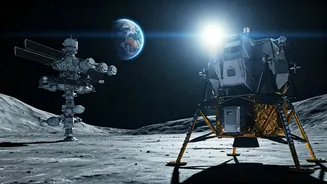
While commerce is a powerful engine, the age-old driver of national prestige is burning brighter than ever. The new space race isn't a simple two-player game; it's a multipolar contest for influence, resources, and technological supremacy. [15, 22] The United States, through its Artemis program, aims to establish a permanent human presence on the Moon. [11, 20] China, in direct competition, is pursuing its own ambitious lunar base, the International Lunar Research Station (ILRS), and plans to land its own astronauts (or 'taikonauts') on the Moon before 2030. [23, 30] Meanwhile, other nations are staking their claims. India became the first country to successfully land a craft on the lunar south pole with its Chandrayaan-3 mission and is planning a sample return mission, Chandrayaan-4, for 2028. [23, 12, 14] The UAE has sent a probe to Mars, and countries across the globe, from Japan to the European Union, are launching sophisticated missions. [10] These programs are not just about planting flags; they are strategic investments designed to showcase technological prowess and secure a seat at the table in shaping the future of off-world governance. [22]
Answering Humanity’s Oldest Questions
Beyond the economic and political motivations, space exploration continues to be driven by a fundamental human quest for knowledge. We are in a golden age of cosmic discovery. Recent data from India's Chandrayaan-2 orbiter suggests the presence of buried ice at the Moon's south pole, a resource that could be vital for future lunar bases. [21] This potential for in-situ resource utilization—turning lunar ice into water, oxygen, and even rocket fuel—is a game-changer for long-term settlement. [21] Missions are also looking further afield. The joint Japan-India LUPEX mission will further investigate lunar water, while probes are planned to explore Mars and its moons. [14, 28] These scientific endeavors are driven by some of our biggest questions: Are we alone in the universe? Can humanity become a multi-planetary species? Finding these answers requires pushing the boundaries of technology and international collaboration, creating a virtuous cycle where scientific discovery fuels technological advancement, which in turn enables more ambitious economic and exploratory goals.
The Blurring Line Between Public and Private
This new era is defined by an unprecedented level of public-private partnership. Government agencies like NASA are no longer building all their own hardware. Instead, they are increasingly acting as anchor customers, contracting with commercial companies for everything from crew transport to lunar landers. [11] NASA’s Artemis program relies heavily on landers being developed by SpaceX and Blue Origin. [20, 16] This model accelerates development, spurs innovation, and saves taxpayer money. It’s also a global phenomenon. India has seen its space startup ecosystem grow from a single company to over 400 in recent years, a boom spurred by policy changes encouraging private participation. [14] In China, the government is actively encouraging commercial companies to participate in major national projects and develop key technologies like reusable rockets. [32, 30] This hybrid approach is creating a more resilient and dynamic ecosystem, where national goals are achieved through commercial competition and innovation.