


The Case of the Misbehaving Asteroid
Imagine a detective story set in our solar system. The suspects are asteroids and comets, two distinct types of celestial bodies. Asteroids are typically rocky and metallic, found mostly in the asteroid belt between Mars and Jupiter. Comets, on the other
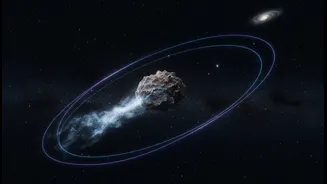
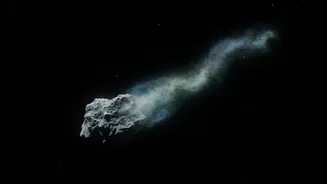
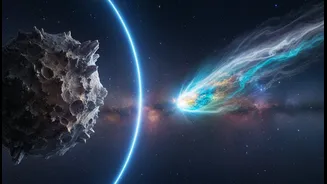
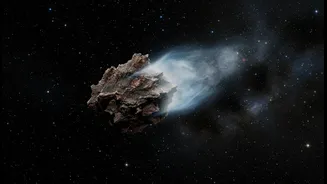
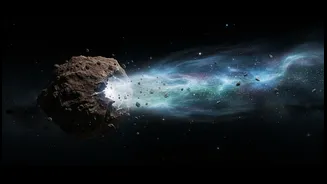
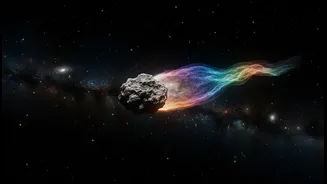
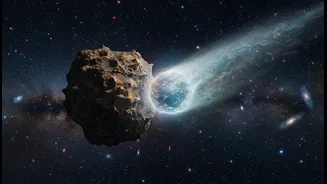
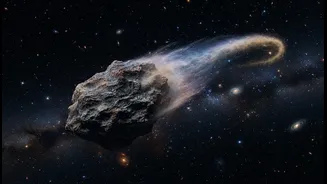
hand, are icy bodies from the outer solar system. When they near the Sun, their ice turns to gas, creating a glowing coma (atmosphere) and a spectacular tail. The lines are usually clear. But recently, astronomers have been finding objects that blur this distinction. These are the so-called “active asteroids” or “main-belt comets”—objects with the orbit of an asteroid but the appearance of a comet. They look like simple space rocks until, unexpectedly, they sprout a tail. This puzzling behaviour forces scientists to reconsider the tidy definitions they have relied on for decades and provides a fascinating live mystery for students and stargazers to follow.
An Object's Orbit Tells Its Story
The first clue in any celestial investigation is the orbit. An object's path around the Sun reveals its origin story. Comets typically have highly elliptical, or stretched-out, orbits that take them from the frigid outer reaches of the solar system, like the Kuiper Belt or Oort Cloud, to the warm inner solar system and back again. Their icy nature is a direct result of forming and living in these deep-freeze regions. Asteroids, however, tend to have more circular orbits and reside closer to the Sun, primarily in the main asteroid belt. The temperatures there are generally too warm for ice to survive on the surface for billions of years. So, when an object is found in a classic asteroid-belt orbit but displays a comet-like tail, it raises a fundamental question: how can it have any ice left to sublimate? It’s like finding a pristine snowman in the middle of a desert. This is why comparing an active asteroid's orbit to that of a traditional comet is the first step in unlocking its secrets.
Chasing a Ghostly and Puzzling Tail
The tail is the most dramatic clue. In a typical comet, the tail is composed of gas and dust pushed away from the Sun by solar wind and radiation pressure, always pointing away from the star. But the tails on active asteroids can be strange and faint. Sometimes, the activity is not caused by sublimating water ice but by other processes. For instance, a recent collision with another small asteroid could have kicked up a cloud of dust that now trails the object. Another possibility is that the asteroid is spinning so fast that it starts to fling material off its surface. Some puzzling objects have even shown tails that seem to point in the wrong direction. The interstellar object 3I/Atlas, for example, displayed a bizarre 'anti-tail' that pointed towards the Sun before it later developed a more conventional one. Analysing the shape, composition, and behaviour of the tail helps scientists determine whether the activity is driven by ice, dust, or something else entirely.
The All-Important Hunt for Volatiles
The ultimate goal is to understand what these objects are made of, which brings us to the hunt for “volatiles.” Volatiles are chemical elements and compounds with low boiling points, such as water, carbon dioxide, and methane. On comets, these are the ices that turn to gas to form the coma and tail. Finding direct evidence of sublimating water ice on an object in the asteroid belt is a game-changer. It suggests that pockets of ancient ice might be preserved just beneath the dusty surface of some asteroids, protected from the Sun's heat. If true, these main-belt comets could be a missing link in understanding the solar system's history. They might represent a source of water that was delivered to the inner planets, including Earth, billions of years ago. By studying the light reflected from the object's coma using spectroscopy, astronomers can identify the chemical signatures of these volatiles, confirming whether they are witnessing a true comet in asteroid's clothing.