


The Ringed Planet Takes Centre Stage
Saturn is the undisputed star of the late-August night sky. The gas giant is steadily growing brighter and larger as it moves towards its ‘opposition’ in early October. Opposition is the point in a planet's orbit when Earth passes directly between it and the Sun.
This alignment makes it the best time of the year to view a planet, as it will be at its closest to us and visible for the entire night. Starting in late August, Saturn rises in the east around sunset and remains a brilliant, yellowish point of light in the sky all night long, tracking across the southern sky. While the famous rings are only visible through a telescope, even with the naked eye, its steady, majestic glow is unmistakable. Towards the end of the month, from August 28 to 31, the nearly full Moon will pass close to Saturn, creating a beautiful pairing in the sky.
A Dazzling Welcome to the Evening
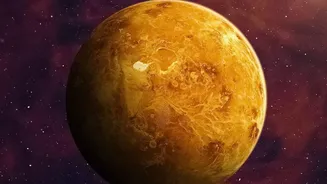
You don’t have to wait long after sunset for the first celestial showstopper to appear. The planet Venus is currently dominating the western evening sky, shining with a brilliant, steady light. Often called the 'Evening Star,' its brightness is so intense that it's frequently the first ‘star’ to become visible after the Sun goes down. Throughout August, Venus will be an unmissable beacon in the west. If you look on the evening of August 19, you will be able to see it sharing the sky with the First Quarter Moon. It provides a perfect and easy target for even the most casual sky-watcher. All you need to do is look west in the hour or so after sunset to catch its spectacular gleam before it sinks below the horizon.
Connect the Dots with the Summer Triangle
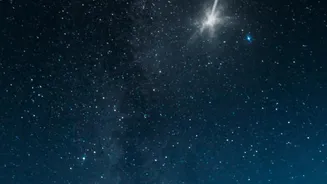
High overhead on August evenings is one of the Northern Hemisphere’s most famous star patterns: the Summer Triangle. This is not a formal constellation but an asterism, a simple shape formed by three of the brightest stars in the sky. These three stars—Vega, Deneb, and Altair—each belong to their own separate constellations. Vega, the brightest of the three, is part of Lyra, the Harp. Deneb is the tail of Cygnus, the Swan, and Altair is the brightest star in Aquila, the Eagle. You can't miss this giant triangle, which hangs almost directly overhead around 10 or 11 p.m. It serves as a fantastic celestial roadmap. Once you locate it, you can begin to trace the shapes of the constellations around it, making it a perfect starting point for anyone new to stargazing.
Glimpse the Heart of Our Galaxy
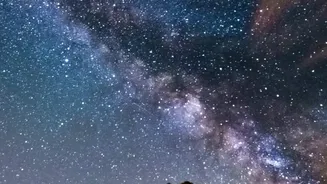
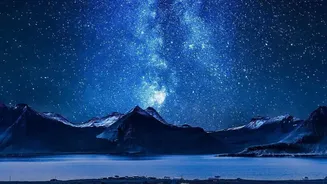
The Summer Triangle also points the way to one of the most breathtaking sights the night sky has to offer: the Milky Way. On a clear, moonless night away from city lights, you will see a faint, hazy band of light stretching across the sky, passing right through the Summer Triangle between the stars Vega and Altair. This is the combined light of billions of distant stars in the core of our home galaxy. Late summer provides an excellent window to view the galactic centre. The key to this experience is finding a dark location. Light pollution from cities washes out this delicate structure completely. As the Moon grows fuller towards the end of August, the best time to see the Milky Way will be in the earlier part of the night before the Moon rises or becomes too bright.
Catch the Early Morning Planet Parade
If you're an early riser, the celestial show continues just before dawn. While Venus commands the evening, Mars and Jupiter are putting on a display in the pre-dawn hours. The red planet, Mars, rises in the east a few hours after midnight and will be visible as a distinct, reddish point of light before the sun comes up. Following it is the giant of our solar system, Jupiter. It is returning to the morning sky and rises in the east as a very bright object not long before sunrise. Seeing these planets requires setting an alarm, but being able to spot multiple worlds in the quiet hours before dawn is a rewarding experience that offers a completely different perspective of the night sky.