







Europe's First Total Eclipse in a Generation
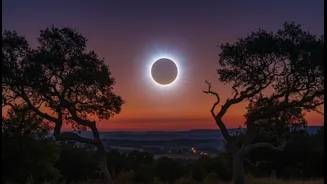
A total solar eclipse occurs when the Moon passes directly between the Sun and Earth, completely obscuring the Sun's face. For a few precious minutes, day turns to an eerie twilight, and the Sun's ethereal outer atmosphere, the corona, becomes visible
to the naked eye. What makes the August 12, 2026, event so significant is its location. It will be the first total solar eclipse visible from mainland Europe since 1999, ending a 27-year celestial drought for the continent. The path of totality—the narrow track where the full eclipse can be viewed—will begin over the Arctic, cross Greenland and Iceland, and then make landfall over northern Spain in the evening. While totality will last for just over two minutes at most, its arrival over a densely populated and easily accessible part of the world makes it one of the most anticipated astronomical events of the decade.
The View from India and Around the World
Unfortunately for skywatchers in India, the total solar eclipse will not be visible. The path of totality is confined to the Arctic, North Atlantic, and parts of Europe. Most of Europe, parts of North Africa, and even a sliver of North America will witness a partial eclipse, where the Moon covers only a portion of the Sun. Some calculations suggest a very minor partial eclipse, with about 14% of the Sun obscured, might be theoretically visible from the extreme northern tips of Ladakh, but this remains unconfirmed. However, the digital age ensures that no one has to miss out. Numerous scientific organisations and space agencies like NASA are expected to host live streams of the event, allowing people from India and across the globe to witness the spectacle in real-time.
A Sunset Spectacle and Scientific Bonanza
One of the most unique aspects of this eclipse is its timing. For viewers in Spain, totality will occur just an hour or so before sunset. This creates the potential for an incredibly dramatic and photogenic event, with the eclipsed Sun hanging low over the western horizon. This low position offers a different kind of visual experience compared to midday eclipses. Beyond its beauty, the eclipse is a major scientific opportunity. Eclipses provide a rare chance to study the Sun's corona, the superheated outer atmosphere that is usually invisible. NASA is sending nearly 40 scientists to Iceland with high-altitude research aircraft and atmospheric balloons to study the corona and how Earth's atmosphere reacts to the sudden loss of sunlight. The findings could improve our understanding of space weather, which impacts satellite communications and power grids.
A Celestial Double Feature
As if a total solar eclipse weren't enough, another celestial event will share the stage. The eclipse coincides with the peak of the annual Perseid meteor shower. Active from mid-July to late August, the Perseids are known for producing bright, frequent meteors—often up to 100 per hour in ideal conditions. In 2026, the shower's peak on the night of August 12-13 will occur during a new moon, meaning the skies will be perfectly dark for meteor watching. There's even a chance that some particularly bright meteors, known as fireballs, could be visible during the brief darkness of the eclipse itself. This cosmic coincidence of an eclipse and a peak meteor shower offers a truly unique opportunity for stargazers.
The Human Element: Eclipse Tourism and Shared Awe
Total solar eclipses are profound human events that have captivated cultures for millennia. The 2026 eclipse is already generating immense interest, with a wave of "astro-tourism" expected in Spain and Iceland. Tour companies are offering elaborate packages, with viewing parties planned at historic castles and hilltop wineries. These events are about more than just seeing an eclipse; they are a chance for people from diverse backgrounds to gather and share a moment of collective wonder. For those within the path of totality, the experience is often described as deeply moving—the temperature drops, animal behaviours can change, and the sight of the Sun's corona is an unforgettable connection to the cosmos. It's a powerful reminder of our place in a vast and dynamic universe.