




The Art of Getting There: Precision Navigation
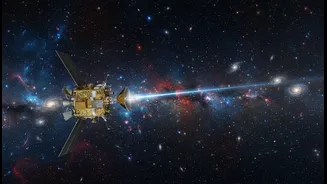
Deep space navigation is the monumental task of steering a craft through the vast, empty ocean of space to a precise destination. Unlike using GPS, which only works near Earth, this requires a completely different toolkit. The backbone of this effort
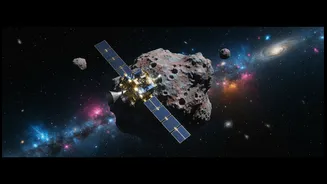
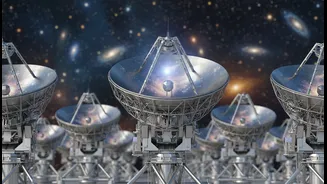
is NASA's Deep Space Network (DSN), a trio of massive radio antenna complexes in California, Spain, and Australia. By sending and receiving precisely timed radio signals, navigators on Earth can track a spacecraft's position, speed, and direction. They measure the Doppler shift in these signals to calculate velocity and use a technique called interferometry, where multiple antennas work together, to pinpoint the craft's location against the background of distant stars. This process is a delicate dance of mathematics and engineering, accounting for the gravitational pull of planets, the Sun, and even the gentle push of solar radiation on the spacecraft. For the final approach, missions often switch to autonomous optical navigation, where the spacecraft's own cameras identify surface features like craters or boulders on the target body to guide itself to a specific landing or impact site, as seen in missions like OSIRIS-REx and DART.
The Science of What We Find: Asteroid Science
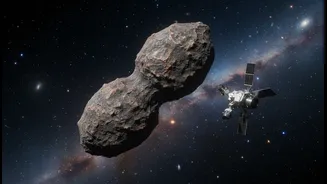
While navigation is about the journey, asteroid science is about the destination. This interdisciplinary field seeks to understand the origins of our solar system by studying these leftover building blocks. Planetary scientists, geologists, and chemists work to answer fundamental questions. What are asteroids made of? By using instruments like spectrometers, they analyze the light reflecting off an asteroid's surface to map its chemical and mineral composition, looking for everything from rock and metal to water and organic molecules—the precursors to life. Why do they orbit the way they do? Scientists track their trajectories to understand how they formed and evolved, and to identify any that might pose a threat to Earth. The DART mission, for example, wasn't just an impact test; it was a large-scale experiment in celestial mechanics to see how we might deflect a hazardous object. By studying samples returned to Earth, like from Japan's Hayabusa2 and NASA's OSIRIS-REx, scientists can analyze pristine, 4.5-billion-year-old material in labs to unlock secrets about how planets formed.
Two Sides of the Same Mission Coin
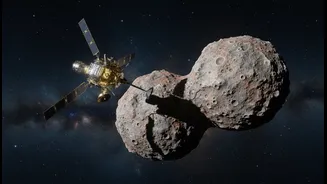
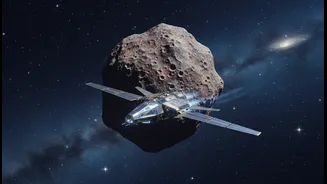
Missions to asteroids are where these two fields collaborate most spectacularly, yet remain distinct. Consider NASA’s DART (Double Asteroid Redirection Test) mission. The navigation team's job was purely one of guidance: to get a vending-machine-sized spacecraft to hit a 160-metre-wide moonlet named Dimorphos, 11 million kilometres away. They succeeded, using an autonomous navigation system called SMART Nav that guided the craft to its target. The success of the impact itself was the navigation achievement. But the point of the mission was a question for planetary science: How much would the impact move the asteroid? Scientists on the ground then spent months using telescopes to measure the change in Dimorphos's orbit, confirming that the kinetic impact technique works for planetary defense. The navigation team got the spacecraft there; the science team measured the results to gain new knowledge. One team pilots the ship, the other explains the new world it has reached.
Why This Distinction Is Important
Blurring the line between precision navigation and asteroid science does a disservice to both. Appreciating them as separate disciplines allows us to celebrate different kinds of success. A mission can have a navigational triumph even if its scientific instruments fail, or it can yield groundbreaking science despite a rough landing. For students in India and beyond aspiring to a career in space, understanding the difference is crucial. One path leads to engineering, software development, and robotics, focusing on control systems and trajectory optimization. The other leads to physics, geology, and chemistry, focusing on data analysis, hypothesis testing, and discovery. By separating these fields in our minds, we gain a deeper appreciation for the complexity of space exploration. It is a partnership between the engineers who chart the course and the scientists who interpret the destination. Each relies on the other, but their expertise, goals, and measures of success are fundamentally different.