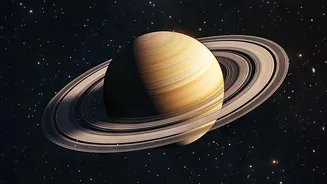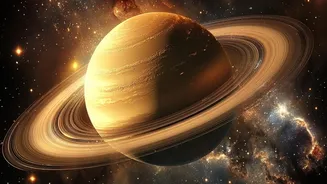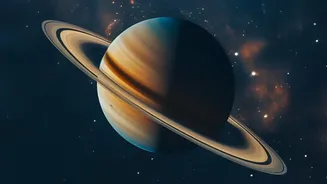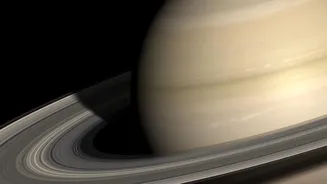





A New Polygon in the Solar System
For decades, scientists have been captivated by a bizarre, six-sided jet stream at Saturn’s north pole, known as the hexagon. It’s a remarkably stable feature, wider than two Earths, that has puzzled observers since it was first seen in the 1980s. Researchers
long searched for a similar structure at the south pole, but NASA's Cassini spacecraft, which orbited the planet from 2004 to 2017, found no such long-lived formation. Now, that has changed. Recent analysis of Hubble Space Telescope images has revealed a giant, ten-sided pattern, or decagon, encircling the southern pole. This discovery was a complete surprise, offering a rare chance to watch a massive atmospheric phenomenon develop in real time.
A Planet Under Watchful Eyes
The discovery of the southern decagon is a testament to the power of long-term observation. The breakthrough came from the Outer Planet Atmospheres Legacy (OPAL) program, which uses the Hubble Space Telescope to take annual snapshots of our solar system's outer planets. By piecing together images taken since 2023, scientists were able to spot the decagon taking shape and growing more distinct over time. The initial hints were first noticed in 2024 by a team that included amateur astronomers who contribute images to a global database. This collaboration between professional researchers and dedicated sky-watchers was crucial, filling an observational gap left after the Cassini mission ended. The find highlights just how dynamic and changeable these distant worlds can be.
Studying a Storm from 800 Million Miles Away
So how do scientists study a weather pattern from such an immense distance? The primary method involves analyzing images from powerful telescopes like Hubble across different light filters. This allows them to see the structure at various atmospheric depths, revealing that the decagon is not just a cloud-top pattern but a deep, vertical wave extending through multiple layers of the atmosphere. Researchers also look for changes in color and temperature. For example, Saturn's northern hexagon famously changed from blue to gold as its seasons shifted, likely due to sunlight creating photochemical haze. Scientists will watch for similar changes in the south. Furthermore, computer simulations are being developed to model the atmospheric dynamics, helping to test theories about how and why such a regular, many-sided shape could form and persist.
Unlocking the Secrets of Seasonal Change
Saturn's seasons last more than seven Earth years each, and the planet's south pole is currently emerging from a long, dark winter into summer. This seasonal shift is critical to understanding the new wave. The timing of its appearance suggests it may be a seasonal phenomenon, perhaps triggered by the changing sunlight and temperatures at the pole. Scientists theorize that as air descends over the pole, it gets compressed and heated, creating large-scale vortices. The James Webb Space Telescope (JWST) is also playing a role. Its infrared instruments can probe Saturn's temperatures and chemical composition, providing new insights into how seasonal changes affect the planet's circulation patterns and drive the evolution of these polar storms.
What the Wave Tells Us About Saturn
Beyond being a celestial curiosity, these polar waves are valuable natural laboratories. Studying their formation and stability provides clues about the forces at work deep inside the gas giant. The precise, geometric shapes are thought to be related to the speed of the planet's jet streams and how they interact with deeper atmospheric layers. The discovery of a decagon, different from the northern hexagon, challenges existing models. Scientists are now investigating whether a nearby swirling vortex, which darkened just before the decagon emerged, might have triggered the initial disturbance. Understanding these colossal weather systems helps scientists refine their models of planetary atmospheres in general, including those of planets beyond our solar system.