
A New Map for Lunar Resources
For years, scientists have known that the Moon's poles likely held water ice, preserved in permanently shadowed craters where sunlight never reaches. Previous missions, including India's own Chandrayaan probes, provided strong evidence for these frozen
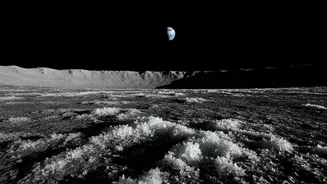
reservoirs. However, the latest astronomical breakthrough provides something far more practical: a detailed map of hydrogen deposits that are believed to be near-surface water ice. This isn't just about knowing water is there; it's about knowing precisely where to find it without having to venture into the most treacherous, dark, and cold craters. This shifts the search from a question of 'if' to a question of 'where,' a critical step for mission planning.
The High-Tech Divining Rod
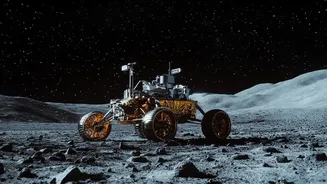
The key to this discovery is an instrument with a futuristic name: the Advanced Neutron Spectrometer. But its function is remarkably clever. The Moon's surface is constantly bombarded by cosmic rays from deep space, which creates a shower of particles, including neutrons. This spectrometer doesn't detect water directly. Instead, it looks for hydrogen—the 'H' in H₂O. When neutrons from the lunar soil travel through material containing a lot of hydrogen, their energy changes in a predictable way. By measuring the energy of neutrons escaping the surface, scientists can infer the presence and concentration of hydrogen below. A significant hydrogen signature strongly suggests buried water ice, allowing astronomers to map it from orbit or with a rover, no drilling required.
Why ‘Accessible’ Is the Magic Word
The most significant aspect of these new findings is the focus on 'accessible' ice. While deep craters may hold vast quantities of pristine ice, they are also incredibly difficult and dangerous to operate in. They are among the coldest places in the solar system, permanently dark, and feature challenging terrain. The newly mapped deposits, however, are located in areas that are easier to reach, potentially lying just a few centimetres below the surface in regions that still receive some indirect sunlight. This makes extraction far more feasible. Instead of requiring complex, robust mining equipment designed for extreme cold and darkness, future missions could potentially use simpler robotic systems to access this vital resource, dramatically lowering the technical barriers for lunar settlement.
Fueling India's Lunar Ambitions
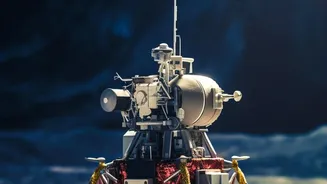
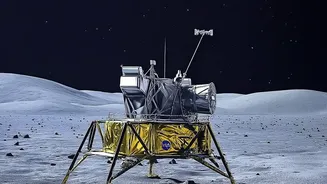
For India's ambitious space program, this news is a major boost. With the success of Chandrayaan-3's south pole landing and the upcoming Gaganyaan human spaceflight mission, ISRO is firmly focused on the Moon. This map of accessible water is particularly relevant for the joint ISRO-JAXA LUPEX (Lunar Polar Exploration) mission, which will specifically search for lunar water resources. Water on the Moon is not just for drinking. Through electrolysis, it can be split into hydrogen and oxygen. This provides breathable air for astronauts and, critically, the two primary components of rocket propellant. Having a local source of fuel could turn the Moon into a refueling station for deep space missions, and India is now better positioned than ever to play a leading role in that future.
The South Pole Gold Rush
The lunar south pole has become the focus of a new, international space race, with agencies from the US, China, and India all planning missions. This is because water is the 'gold' of the 21st-century space era. It is the single most important resource needed to support long-term human habitation beyond Earth. The creation of a reliable resource map using tools like the neutron spectrometer effectively draws the lines for where the first lunar outposts will be established. The nations and private companies that can successfully land, extract, and utilize this water will gain a significant strategic advantage, not just for scientific discovery, but for the burgeoning economy of cislunar space.