

A Storm for the Ages
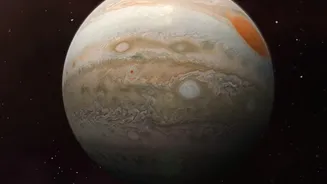
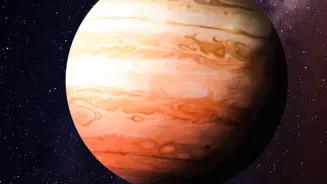
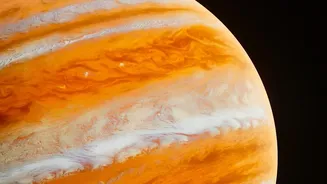
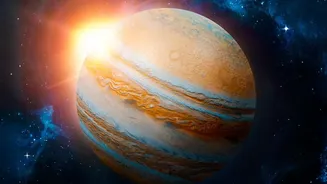
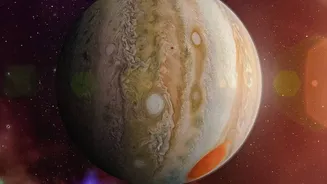
Jupiter's Great Red Spot is the most powerful and persistent storm in our solar system. First observed in detail in the 1800s, and possibly as early as the 1600s, this colossal anticyclone is a high-pressure region in Jupiter's southern hemisphere. For
context, at its historical peak, this single storm was wide enough to swallow three Earths side-by-side. Its deep, reddish hue, believed to be caused by complex chemicals in the planet's upper atmosphere, makes it an unmistakable feature, visible even with Earth-based telescopes. Unlike storms on Earth that lose energy over land, Jupiter has no solid surface to slow it down, allowing the Great Red Spot to rage for centuries.
What the New Captures Reveal
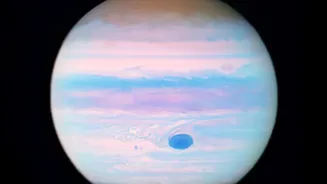
Recent observations, particularly from the Hubble Space Telescope, have given scientists a front-row seat to surprising new behaviours. While astronomers have known since the 1930s that the storm is shrinking, the rate of change has accelerated in recent years. From a width of about 25,500 miles in the late 1800s, it has now shrunk to its smallest measured size of approximately 10,250 miles across. But it's not just shrinking. Detailed observations captured between December 2023 and March 2024 showed the storm is also oscillating in size and shape, wobbling and jiggling in an unexpected manner. Scientists have described it as behaving like a 'squeezed stress ball' or a 'bowl of gelatin'. An unusual, wispy filament has also been seen stretching across the vortex, a feature whose origin is still a mystery.
The Eyes on Jupiter
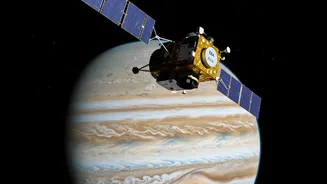
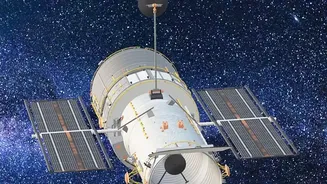
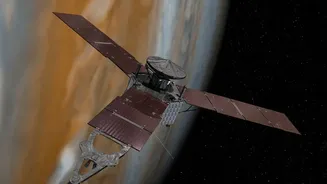
These discoveries are made possible by advanced instruments that provide an unprecedented cadence and resolution. The Hubble Space Telescope, a joint project of NASA and the European Space Agency (ESA), has been a key player. Its long-running Outer Planet Atmospheres Legacy (OPAL) program monitors the outer planets yearly, allowing astronomers to track changes over time. Adding to this, the James Webb Space Telescope (JWST) has turned its powerful infrared gaze on the region. In observations from July 2022, Webb studied the upper atmosphere above the storm, an area once thought to be unremarkable. Instead, it found a host of intricate structures, challenging previous assumptions about Jupiter's atmospheric dynamics. These powerful telescopes work in concert, with Hubble tracking visible changes and Webb exploring the thermal and chemical structure.
The Life and Times of a Giant Storm
The big question is: what do these changes mean? Is the Great Red Spot dying? Scientists are actively debating the storm's future. The shrinking has led some to believe we are witnessing the beginning of its end. The storm's shape has also evolved from a distinct oval to a more circular form. One hypothesis for the accelerated shrinkage is that the storm is being affected by smaller eddies feeding into it, which could be altering its internal energy and momentum. However, the recent discovery of its oscillating size and shape complicates the narrative of a simple decline. This previously unseen behaviour suggests complex internal dynamics that scientists are still working to understand, with no current hydrodynamic models fully explaining it. It may not be dying, but evolving into a new, perhaps more stable, phase of its life cycle.
Why We Watch the Weather on Other Worlds
Studying Jupiter's weather isn't just about one planet. It provides a natural laboratory for understanding atmospheric physics on a massive scale. The forces that drive a storm hundreds of times older than any on Earth can offer profound insights into the mechanics of all planetary atmospheres, including our own. Understanding the dynamics of Jupiter's vortices helps scientists refine their models of hurricanes and other weather systems here on Earth. Furthermore, as we discover more exoplanets orbiting distant stars, knowledge of how gas giant atmospheres work is crucial for determining which of those worlds might be habitable. What we learn from the Great Red Spot today could one day help us understand the weather on a planet light-years away.