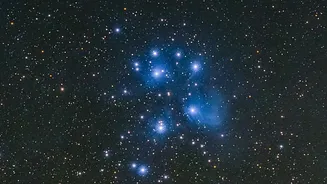







As the air turns crisp this November, the night sky puts on one of its most dazzling shows. Look up, and you might spot a tiny, shimmering cluster of stars. This is the Pleiades, a celestial jewel known in India as the Krittika nakshatra.
What Exactly Are the Pleiades?
The Pleiades,
also called the 'Seven Sisters' or Messier 45, is not a constellation but an open star cluster. It's a gathering of over 1,000 young, hot, blue stars born from the same cloud of gas and dust. To the naked eye, it looks like a small, misty patch of light, and under clear, dark skies, most people can distinguish six to seven of its brightest stars. This beautiful cluster is located about 440 light-years from Earth and is one of the nearest and most easily visible star clusters to us. Its name in Greek mythology refers to the seven daughters of the Titan Atlas and the sea-nymph Pleione.
The Indian Legend of Krittika
In Indian astrology and mythology, the Pleiades are known as the Krittika nakshatra. The cluster holds deep cultural significance, most famously linked to the birth of the warrior god Kartikeya. According to legend, a powerful spark of energy from Lord Shiva was too intense for anyone to hold. It was eventually carried by the river Ganga and nurtured by the six Krittikas, who are considered the wives of the Saptarishis (the seven great sages). They acted as foster mothers to the infant Kartikeya, raising him to become the commander of the celestial armies. This story imbues the star cluster with themes of nurturing, protection, and righteous power.
Why November Is the Best Month to Look
November is considered the month of the Pleiades. During this time, the cluster is visible all night long, from dusk until dawn. It rises in the east shortly after sunset, climbs to its highest point in the sky around midnight, and sets in the west before sunrise. This extended visibility makes it the perfect month for beginner and experienced stargazers alike to get a fantastic view. Across India, the post-monsoon period from October to March offers some of the clearest and most stable skies, making November an ideal time for this celestial pursuit.
A Step-byStep Guide to Finding It
Finding Krittika is easier than you might think. You don't need a telescope, just a clear night and a little patience. 1. Time and Direction: Look towards the eastern horizon from around 10 PM onwards in early November. As the night progresses, the cluster will climb higher. 2. Find the Pointer: The easiest way to locate the Pleiades is to first find the famous constellation Orion, the Hunter. Look for Orion's Belt, a straight line of three bright stars. 3. Follow the Line: Draw an imaginary line through Orion's Belt and extend it upwards and to the right. This line will first point you to a bright, reddish-orange star named Aldebaran, which is the eye of Taurus the Bull. 4. Spot the Cluster: Continue that line a little further past Aldebaran, and you will see a small, tightknit group of stars that looks like a tiny, sparkling dipper. That's it—you've foundthe Pleiades!
Tips forthe Best Viewing Experience
To make your stargazing session memorable, keep these tips in mind:
Escapethe City: Light pollution from cities can wash out fainter stars. Find a location away from bright city lights,
Let Your Eyes Adjust: It takes about $20$-$30$ minutes for your eyes to fully adapt to darkness. Avoid looking at your phone screen,
Checkthe Moon: A bright full moon can make it harder to see star clusters. The best time for stargazing is duringthe new moon phase orthe days surrounding it.
Use Binoculars:** Whilethe Pleiades are a stunning nakedeye object,