



Why Sitting Is the New Smoking for Your Spine
Our bodies are designed for movement, but many of us spend eight hours or more in a chair. Prolonged sitting places significant stress on the back muscles and spinal discs. When you sit, especially with poor posture, you can cause muscle imbalances. The
muscles in your hips (hip flexors) become tight, while your core and glute muscles weaken. This combination forces your lower back to work harder to support your upper body, leading to strain, stiffness, and pain. Over time, this constant pressure can compress the discs in your spine, which act as cushions between your vertebrae, potentially leading to chronic pain and other long-term issues.
The Power of the Micro-Break
The key to counteracting the negative effects of sitting isn't a strenuous, hour-long workout. Instead, the solution lies in frequent, short 'micro-breaks'. Taking just a few minutes every hour to stand up and stretch can make a world of difference. These breaks help to 'reset' your body. They improve blood circulation to tired muscles, rehydrate the spinal discs by creating a gentle pumping action, and release the built-up tension from static posture. Experts recommend setting a timer to remind yourself to get up and move every 30 to 60 minutes. It's a small habit that delivers significant preventative benefits.
Stretch 1: The Seated Cat-Cow
This gentle stretch helps to mobilize your entire spine without even leaving your chair. Sit at the edge of your seat with your feet flat on the floor and your hands on your knees. As you inhale, arch your back, push your chest forward, and look up toward the ceiling (Cow pose). As you exhale, round your spine, tuck your chin to your chest, and let your shoulders and head come forward (Cat pose). Repeat this fluid movement 5 to 10 times to gently wake up your back and improve flexibility.
Stretch 2: The Seated Spinal Twist
A good twist can help relieve tension in the lower back and improve spinal mobility. Sit tall in your chair with both feet flat on the floor. Gently twist your torso to the right, placing your left hand on your right knee and your right hand on the back or arm of the chair to deepen the stretch. Keep your hips facing forward as much as possible. Hold the position for 15 to 30 seconds, breathing deeply, and then slowly return to the center and repeat on the other side. This helps to wring out the stiffness that accumulates from being in one position.
Stretch 3: The Chest Opener
We spend much of our day hunched forward over a keyboard, which tightens the chest muscles and encourages poor posture. To counteract this, perform a chest opener. You can do this by sitting at the edge of your chair and clasping your hands behind your back. Straighten your arms, squeeze your shoulder blades together, and lift your chest proudly towards the ceiling. You should feel a pleasant stretch across your chest and the front of your shoulders. Hold for 15 to 20 seconds. This move is excellent for promoting better posture.
Stretch 4: The Standing Hamstring Stretch
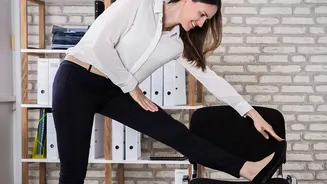
Tight hamstrings can pull on your pelvis and contribute to lower back pain. While you're up on a micro-break, find a clear space. Stand and place the heel of one foot on a slightly elevated surface, like a low stool or a stack of books, keeping that leg straight. Gently lean forward from your hips until you feel a stretch along the back of your thigh. Keep your back straight throughout the movement. Hold for 20 to 30 seconds and then switch legs. This helps to lengthen these often-neglected muscles.