






The Martian Air Problem
Landing on Mars and surviving is no simple task. The planet's atmosphere is a cold, thin veil utterly hostile to human life. It is composed of about 96% carbon dioxide, with only a trace amount of oxygen, making it impossible to breathe. For decades,
the challenge for scientists wasn't just getting to Mars, but figuring out how to live there without shipping every last resource—an astronomically expensive and logistical nightmare. The solution lies in a concept called In-Situ Resource Utilization (ISRU), which essentially means living off the land. By harvesting and processing materials found directly on Mars, future explorers could create their own oxygen, water, and even rocket fuel.
MOXIE: The Little Oxygen Factory That Could
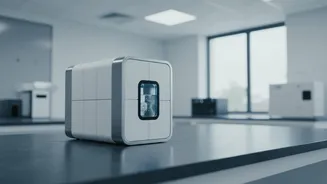
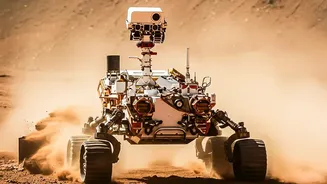
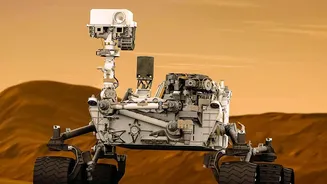
The foundational technology for making air on Mars is called solid oxide electrolysis. Think of it as a tree, but a mechanical one. It inhales the carbon dioxide-rich Martian air, heats it to about 800 degrees Celsius, and uses an electrochemical process to split the CO2 molecules into oxygen and carbon monoxide. This process was successfully proven on Mars by a toaster-sized instrument aboard NASA's Perseverance rover called the Mars Oxygen In-Situ Resource Utilization Experiment, or MOXIE. Between 2021 and 2023, MOXIE consistently produced pure oxygen, proving the core technology works in the harsh Martian environment. In its 16 runs, it generated a total of 122 grams of oxygen, enough for a small dog to breathe for about 10 hours.
The 'Scaled' Breakthrough
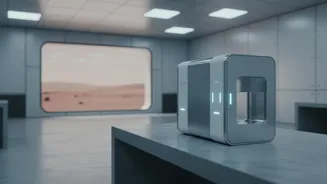
While MOXIE was a phenomenal success, it was always a small-scale prototype. It proved oxygen could be made. The next, and most critical, step is scaling that production up. The headline-making development is the advancement toward a larger, more robust system designed for continuous operation. A full-scale oxygen factory on Mars would need to be hundreds of times larger than MOXIE, capable of running for thousands of hours without fault. Researchers envision a system that could generate oxygen at the rate of several hundred trees. This scaled-up unit would no longer be just an experiment; it would be a piece of essential infrastructure, a true oxygen plant sent to Mars ahead of human arrival. It would need to produce tons of oxygen, not just grams.
Why 'Continuous' is a Game-Changer
MOXIE ran in short bursts, for about an hour at a time, because it shared power with the Perseverance rover's other instruments. A full-scale system for a human base must run continuously. This is the difference between a science demonstration and a reliable life-support system. Continuous operation is vital to produce the sheer volume of oxygen required. Future astronauts would use about one metric ton of oxygen for breathing over the course of a year-long mission. But the real demand comes from rocket fuel. To launch a rocket and lift a crew off the Martian surface for the journey home, an estimated 25 to 30 metric tons of liquid oxygen are needed. Producing this much requires a plant that works non-stop for over a year before the astronauts even arrive.
The Road Ahead: Power and Durability
Despite this progress, significant challenges remain. The biggest hurdle is power. The electrolysis process is energy-intensive, and a full-scale oxygen plant would require a dedicated power source of around 25-30 kilowatts, likely from a robust solar array or a small nuclear reactor. Engineers must also ensure these systems are incredibly durable and autonomous, able to withstand Mars's extreme temperature swings, pervasive dust, and high radiation with minimal human intervention. The lessons learned from MOXIE's operations are now informing the design of these next-generation systems, focusing on efficiency, longevity, and self-cleaning mechanisms to combat the harsh Martian environment.