



The Empire's Second City
To understand the label, we have to travel back in time. For nearly 140 years, from 1772 to 1911, Kolkata—then known as Calcutta—was the grand capital of British India. Its strategic position on the Hooghly River made it a bustling port and the commercial
heart of the East India Company's operations. During this period, it grew to become the second most important city in the British Empire, surpassed only by London itself. The British administration poured immense resources into building a capital that would project imperial power and prestige, modelling its grand buildings and wide avenues on European standards, which naturally led to comparisons with London.
An Architectural Time Capsule
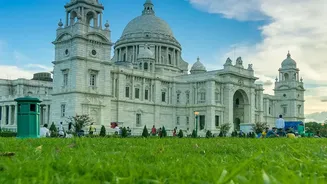
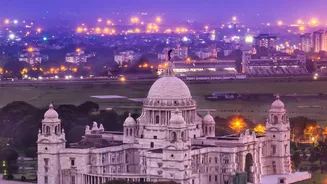
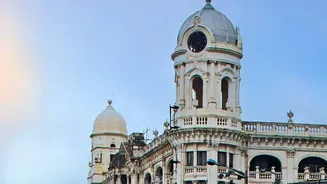
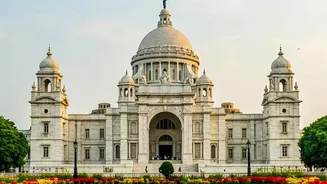
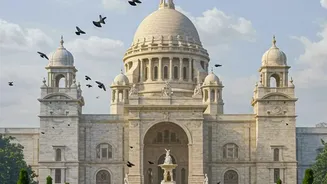
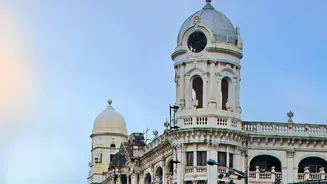
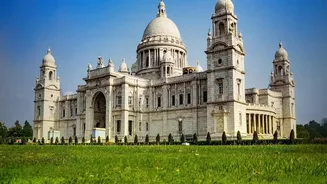
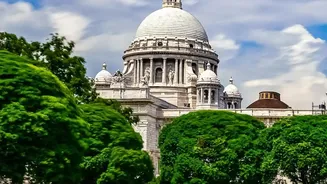
The most visible evidence of the London connection lies in Kolkata's stunning colonial architecture. A walk through the city’s historic core is like stepping into an open-air museum. The area formerly known as Dalhousie Square, now B.B.D. Bagh, was the political and financial nucleus of British India. It is crowded with magnificent structures like the red-bricked Writers' Building, the former administrative headquarters, and the impressive General Post Office with its grand dome. The most iconic of all is the Victoria Memorial, a breathtaking monument of white marble built to honour Queen Victoria. This Indo-Saracenic masterpiece, often called the 'Taj of the British Raj', was envisioned by Lord Curzon and completed in 1921. Nearby stands St. Paul's Cathedral, a Gothic Revival church that was the first Anglican cathedral in Asia.
Life Beyond the Buildings
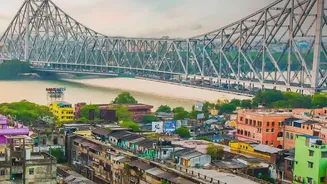
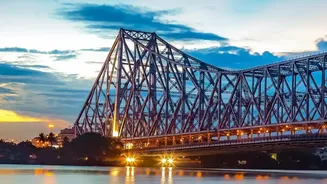
The resemblance to London isn't just skin-deep. Just as London thrived along the River Thames, Kolkata's growth was intrinsically tied to the Hooghly River, which shaped its trade and culture. Another striking parallel is Kolkata's tram system. Introduced in the 19th century, it is the only operating tram network in India, and the sight of these charming vehicles navigating busy streets evokes a distinct old-world European charm. The British influence also seeped into the city's culture, giving rise to a unique intellectual environment. The 19th-century Bengal Renaissance saw the city become a hub for art, literature, and progressive thought, with clubs and societies that mirrored the cultural life of London. Even the city's passion for football, unlike in much of the rest of India, is a cultural echo of its colonial past.
Planning Your Colonial Trail
For travellers looking to experience this history firsthand, a well-planned itinerary is key. The best time to visit is between October and March, when the weather is pleasant. A two or three-day trip is ideal to cover the main highlights. Start your tour at the Victoria Memorial; its museum and sprawling gardens can easily take up a couple of hours. From there, a short walk across the Maidan—the city's vast urban park—will take you to St. Paul's Cathedral. Dedicate another day to exploring B.B.D. Bagh, admiring the Writers' Building, the General Post Office, and St. John's Church, one of the city's oldest churches. You can get around using the metro, which has stations conveniently located near major landmarks, or by hopping into one of the city's iconic yellow taxis.