
The Sun’s Powerful Outbursts
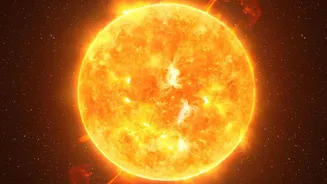
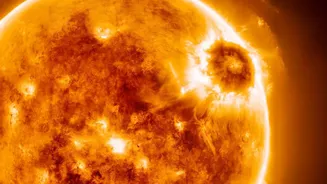
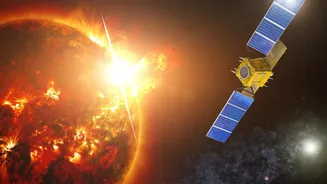
A coronal mass ejection, or CME, is one of the most powerful explosions in our solar system. It's a massive eruption of plasma and magnetic fields from the sun's outer atmosphere, the corona, into space. These events happen when twisted magnetic field lines
on the sun suddenly snap and reconfigure, launching billions of tons of solar material outward at incredible speeds. The fastest CMEs can travel from the sun to Earth in as little as 15 to 18 hours, while slower ones might take several days. Think of it as a cosmic cannonball, expanding as it travels and capable of significantly disrupting the space environment around our planet.
A Threat to Our High-Tech World
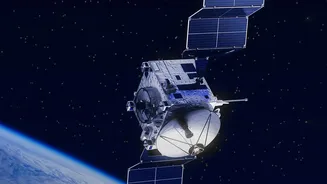
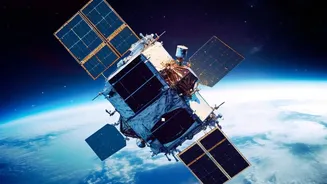
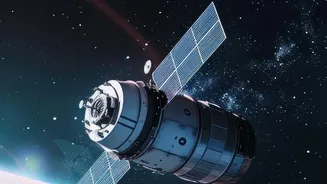
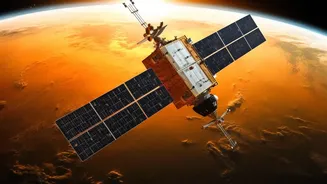
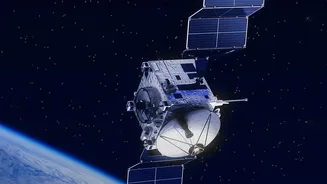
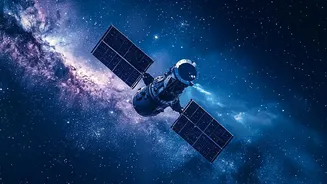
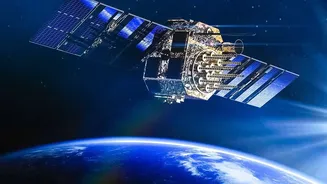
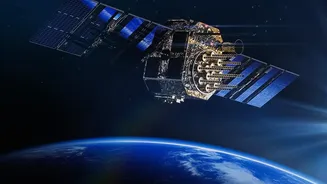
While Earth's magnetic field protects us from the worst effects, a direct hit from a powerful CME can have serious consequences for the technology we rely on. When a CME slams into our magnetosphere, it can trigger a geomagnetic storm. These storms can induce powerful electrical currents in long conductors on the ground, such as power lines and pipelines. In a worst-case scenario, this can overload transformers and lead to widespread, long-lasting blackouts, as happened in Quebec in March 1989. In space, the danger is even more acute. Satellites can suffer from electronic circuit damage, and increased atmospheric drag can alter their orbits. Our GPS, radio communications, and even undersea internet cables are also vulnerable.
The Science of Solar Forecasting
To protect against these threats, scientists don’t just watch for CMEs; they actively forecast their journey and potential impact. This is where impact modeling comes in. Using data from a fleet of solar observatories, like NASA's Solar and Heliospheric Observatory (SOHO), forecasters can spot a CME as it leaves the sun. They analyze its size, speed, and direction to determine if it's heading toward Earth. This initial data becomes the crucial input for sophisticated computer models that simulate the CME's path through space, providing a warning 1-4 days in advance. It's a complex process that turns astronomical observation into actionable intelligence.
How the Models Actually Work
The primary tool used by forecasters at NOAA's Space Weather Prediction Center (SWPC) is a complex modeling system called WSA-Enlil. This system is actually two models working together. The Wang-Sheeley-Arge (WSA) part uses observations of the sun's magnetic field to estimate the state of the solar wind near the sun. Then, the Enlil model (named for the Mesopotamian god of storms) takes over. It's a 3D simulation that models how that plasma cloud will travel, stretch, and interact with the normal solar wind as it moves through the inner solar system. The model predicts the CME's arrival time, its density, speed, and—most importantly—the orientation of its magnetic field, which is the key factor in determining how severely it will disrupt Earth's magnetosphere.
From Forecast to Actionable Protection
A multi-day forecast is the critical window needed to prepare. With a reliable warning from models like WSA-Enlil, infrastructure operators can take protective measures. Satellite operators can power down non-essential, sensitive electronics and reorient their spacecraft to minimize damage. Power grid managers can adjust their system loads and delay maintenance to increase resilience against induced currents. Airlines can reroute polar flights, which are more exposed to solar radiation and communication disruptions during a storm. These models don't stop the storm, but they provide the crucial lead time needed to brace for impact, turning a potential catastrophe into a manageable event and safeguarding the technological backbone of our modern society.