






The AI-Powered Eye in the Sky
In the vastness of space, the challenge isn't just seeing, but understanding. India is increasingly turning to artificial intelligence to make sense of the petabytes of data its Earth-observation satellites collect. Startups like Bengaluru-based Pixxel
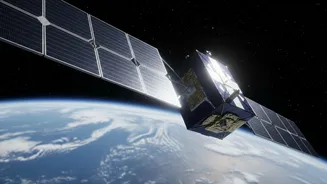
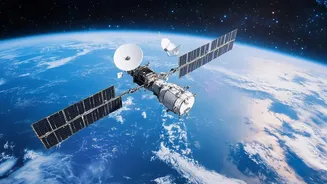
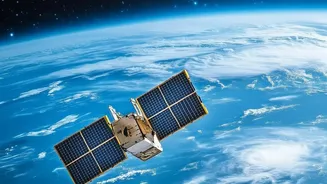
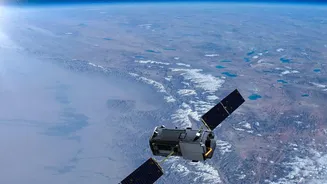
and Digantara are at the forefront of this shift. Instead of beaming raw data down for humans to analyze, AI-powered systems are being developed to process information directly on the satellite. This on-board processing allows for faster, more efficient analysis for everything from agricultural monitoring and disaster management to tracking maritime movements and logging deforestation. Another critical application is managing the increasingly crowded environment of low-Earth orbit. AI algorithms are being used to track over a million pieces of space debris, predicting potential collisions with operational satellites and ensuring the safety of billion-dollar assets. This move towards autonomous satellite operations is seen as essential for ensuring the long-term sustainability of space activities.
Quantum Keys to Unbreakable Links
While AI is making satellites smarter, quantum technology is being developed to make their communication links virtually unbreakable. Traditional encryption relies on complex math problems that, in theory, could be broken by powerful future computers. Quantum communication, however, is based on the laws of physics. India's space agency, ISRO, is actively experimenting with a technology called Quantum Key Distribution (QKD). In simple terms, QKD uses entangled particles of light (photons) to create a secret key between two parties. The very act of a third party trying to intercept or observe these particles would disturb them, immediately revealing the presence of an eavesdropper. ISRO has already successfully demonstrated QKD over a distance of 300 meters, transmitting encrypted images and even holding a secure video conference. The ultimate goal is Satellite-Based Quantum Communication (SBQC), which would create a hack-proof channel for sensitive military, financial, and governmental data across the country.
From National Pride to Strategic Necessity
India’s ambitions in advanced space tech are driven by more than just scientific curiosity. After historic policy reforms in 2020 opened the sector to private companies, a new ecosystem has emerged. The creation of IN-SPACe, a single-window agency to promote private participation, has spurred a boom in space startups. This shift is part of a broader strategy to achieve what officials call "strategic autonomy." In a world where space assets are critical for national security and economic stability, India is determined to reduce its reliance on foreign technology and data providers. Developing its own secure communication networks and advanced surveillance capabilities is seen as a vital defense mechanism, particularly with a technologically advanced neighbor like China. Furthermore, these technologies position India as a competitive player in the global space economy, capable of offering secure and sophisticated satellite services to other nations.
A New Player in a High-Stakes Game
India's progress isn't happening in a vacuum. The United States and China are also investing billions in weaponizing AI and quantum science for space applications. This three-way race is redefining geopolitical alliances and military strategy. By developing these dual-use technologies, India is elevating its status as a major technological power. This makes it a more valuable strategic partner for the U.S. in frameworks like the Quad, which aims to counterbalance China's influence in the Indo-Pacific. At the same time, it establishes India as a formidable competitor. The National Quantum Mission, with a budget of over $700 million, is a clear signal of the country's intent to become a leader, not a follower, in these frontier technologies. The advancements aim to secure everything from financial markets and government communications to military operations, creating a technological shield for its billion-plus citizens.