




An Observatory on Two Continents
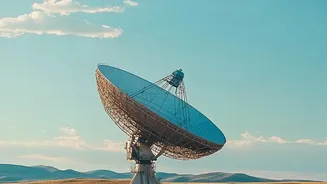
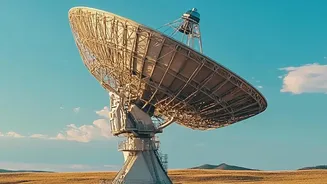
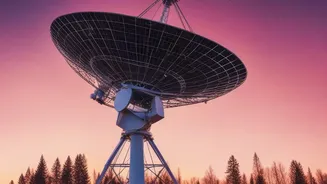
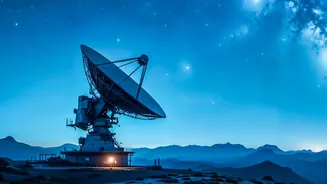
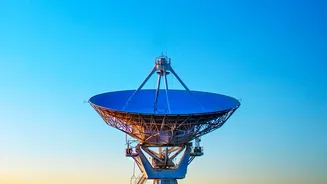
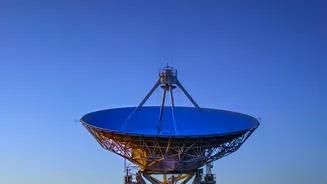
The Square Kilometre Array isn't just one telescope; it's a globe-spanning scientific instrument made of two distinct arrays, managed by the SKA Observatory (SKAO). First, there's SKA-Mid in South Africa's Karoo region, which will eventually consist of 197
traditional-looking dish antennas. Its counterpart is SKA-Low, located in Western Australia on Wajarri Yamaji Country, which will feature over 131,000 small, tree-like antennas. By placing these arrays in remote, radio-quiet deserts and linking them together through a technique called interferometry, scientists create a virtual telescope of unprecedented scale and sensitivity, far more powerful than any single dish could ever be.
The Cosmic Noise Problem
The primary goal is to detect faint radio waves from a period known as the Cosmic Dawn, when the very first stars and galaxies began to shine, between 200 and 600 million years after the Big Bang. Before this, the universe was a dark place filled with neutral hydrogen gas. As the first stars ignited, they emitted a faint radio signal at a specific wavelength of 21 centimetres. Due to the expansion of the universe, this ancient signal has been stretched (or redshifted) to much lower frequencies. The problem is that this incredibly faint whisper is buried under a cacophony of much louder radio noise from our own galaxy, countless other galaxies, and even our own technology on Earth. This foreground noise can be thousands of times stronger than the signal scientists are trying to find.
Advanced Dishes and Signal Transport
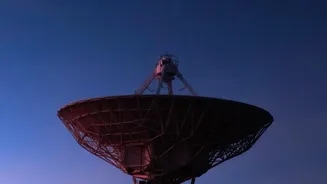
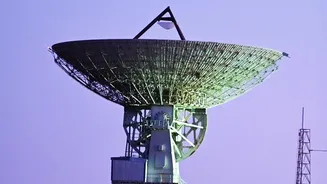
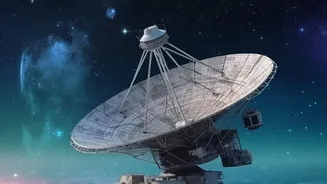
The headline's 'dishes' refer mainly to the SKA-Mid telescope in South Africa. Each of the 197 dishes acts as a collector, gathering faint radio waves from the cosmos. What makes them 'advanced' isn't just their size but the entire system. Cryogenic receivers, cooled to just a few degrees above absolute zero, are used to minimize noise generated by the electronics themselves, boosting their ability to detect incredibly weak signals. Once a signal is collected, it's not sent through traditional coaxial cables, which can degrade the signal over long distances. Instead, the SKA uses advanced radio-frequency-over-fibre (RFoF) technology to transport the pristine analogue signal from the antenna to a central processing facility with minimal loss.
Filtering Through Supercomputing
This is where the real 'filtering' begins. The analogue data from thousands of antennas are digitised, creating a data flood of mind-boggling proportions—terabits per second, far exceeding global internet traffic. This raw data is fed into the Central Signal Processor, the 'brain' of the telescope. This supercomputing powerhouse uses complex algorithms to correlate the data from every pair of antennas. It's not a simple filter you can buy at a store; it is a multi-stage process of digital signal processing. Teams use sophisticated techniques to model and subtract the bright foreground sources—both compact and diffuse—to isolate the desired frequency range where the Cosmic Dawn signal is believed to be hiding. It’s an immense computational challenge, requiring some of the fastest supercomputers on Earth to perform countless Fourier transforms and iterative calibrations to clean the data and create a final image.
Imaging the Dawn of Time
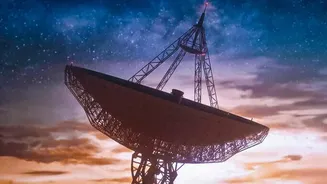
The ultimate scientific prize is to create three-dimensional maps of the neutral hydrogen gas during the Cosmic Dawn and the subsequent Epoch of Reionization, when light from the first stars ionized the surrounding gas. By observing how the 21-cm signal changes over different redshifts (which correspond to different times in cosmic history), the SKA will be able to trace the evolution of the early universe. It will effectively take snapshots of the universe as the first lights were turning on, revealing the properties of the first stars and galaxies and how they reshaped the cosmos. This has been a primary science driver for the SKA project since its inception, promising to revolutionize our understanding of our own cosmic origins.