







Quantum Theory’s Imaginary Friend
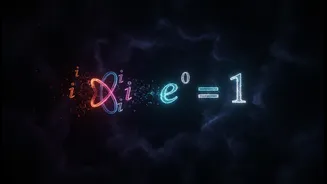
For nearly a century, quantum mechanics, the science of the very small, has been built on a curious foundation: complex numbers. These are numbers that have a “real” part and an “imaginary” part, the latter involving the square root of -1, often written
as 'i'. Even the pioneers of quantum theory, like Erwin Schrödinger, were a bit uneasy about relying on a mathematical tool that doesn't seem to correspond to anything physically measurable. After all, you can't hold 'i' apples. Yet, complex numbers proved incredibly effective for describing the wave-like behaviour and strange properties of subatomic particles. They became a standard and essential part of the physicist's toolkit, used to calculate everything from the energy levels of atoms to the behaviour of quantum computers.
The Case for a 'Real' Alternative
Given this long-standing reliance on imaginary numbers, some physicists have always wondered: are they truly necessary? Could a version of quantum theory be built using only real numbers—the kind we use for everyday counting and measurement? The appeal is intuitive; it feels more natural to build a theory of reality on, well, real numbers. For many years, attempts to do so were cumbersome or incomplete. While you can technically rewrite any complex equation using pairs of real numbers, these early real-number theories couldn't quite reproduce all the successful predictions of the standard, complex version of quantum mechanics.
Putting Theories to the Test
The debate moved from chalkboards to laboratories. In 2021, a team of physicists proposed a clever experiment, based on the principles of a Bell test, to finally settle the question. Bell tests are famous for proving that the quantum world is fundamentally strange and doesn't follow our classical intuitions about local reality. This new version was designed to see if a real-number version of quantum theory could predict the same experimental outcomes as the standard complex-number version. The experiment involved a network of entangled particles, and the theorists predicted that a real-number theory would have a lower limit on the correlations it could produce compared to complex theory. When the experiments were actually performed, the results sided with standard quantum mechanics, suggesting that complex numbers were indeed essential.
A New Twist in the Tale
Just when the case seemed closed, a new development in mid-2026 has reopened it. Researchers pointed out that the 2021 experiment and its conclusion rested on a key assumption about how different quantum systems are mathematically combined. They argued that if you use a different, but still physically valid, rule for combining systems in a real-number framework, you can build a version of quantum mechanics that is entirely consistent with all experimental results, including the ones that seemed to rule it out. This new formulation essentially uses a more sophisticated bookkeeping system for pairs of real numbers that mimics the behaviour of a single complex number. The result is a real-number theory that makes identical predictions to the standard one, suggesting 'i' might just be a convenient shortcut rather than a fundamental necessity.
Your Verification Checklist
When you see a headline about a major scientific shake-up, it’s wise to be curious but cautious. Here’s what to check before you share: 1. Look for Experimental Proof: A theory is just an idea until it's tested. The real-number quantum debate is a perfect example of how experiments are designed to distinguish between competing ideas. A claim without experimental data is just speculation. 2. Check for Peer Review: Has the research been published in a reputable, peer-reviewed journal like Nature or Physical Review Letters? This means other experts in the field have vetted the work for errors and rigor. It isn’t foolproof, but it’s a critical quality filter. 3. Understand the Assumptions: As the latest twist shows, scientific conclusions often depend on underlying assumptions. Good science reporting will explain what those assumptions are. Be wary of reports that present a finding as absolute and final without mentioning the context or limitations. 4. Wait for Consensus: A single study, even a groundbreaking one, is rarely the final word. Science progresses as other teams replicate, challenge, and build upon new results. The broader scientific community will debate and test the new real-number framework before it's widely accepted. True breakthroughs stand the test of time and scrutiny.