




A Cosmic Starter Kit
Recent breakthroughs in astrochemistry are radically changing our perspective on the origin of life. Scientists have found compelling evidence that many of the essential molecular building blocks for biology do not need a warm, watery planet to form.
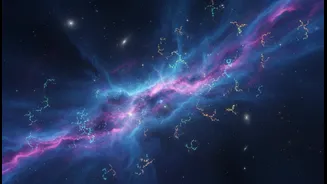
Instead, they can be created in the vast, frigid expanses of interstellar space, on the surfaces of tiny dust grains floating in molecular clouds. This suggests that young planets, including the early Earth, may have been seeded with a chemical 'starter kit' for life, delivered via comets and asteroids. This cosmic delivery system could have given life a significant head start.
The Peptide Puzzle
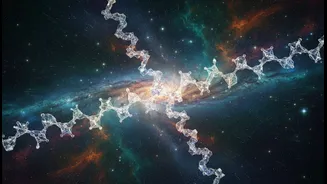
One of the biggest puzzles in origin-of-life research has been the formation of peptides. Peptides are short chains of amino acids, and when they link together, they form proteins—the molecular workhorses of all living cells. Previously, it was widely assumed that amino acids could only link into peptides in the presence of liquid water, meaning this crucial step had to occur on a planetary surface. However, forming these bonds in a 'primordial soup' on Earth presents many chemical challenges. The new research offers a compelling alternative. Laboratory experiments simulating the conditions of deep space—ultra-high vacuum, temperatures just above absolute zero, and cosmic radiation—have shown that amino acids like glycine can spontaneously link together to form peptides on the surface of icy dust grains.
A Breakthrough in the Dust
Multiple recent studies have provided powerful evidence for this new pathway. Researchers have demonstrated that by bombarding frozen layers of amino acids with radiation similar to the cosmic rays found in space, they can trigger the formation of dipeptides, the simplest peptide chains. This process creates the crucial peptide bond without any liquid water, completely bypassing a major theoretical hurdle. It indicates that the chemistry leading to proteins can begin in the stellar nurseries where stars and planets are born. This makes the chemical precursors to life potentially much more widespread throughout the universe than previously thought.
More Than Just Peptides
The cosmic cookbook for life isn't limited to peptides. In a landmark discovery from July 2026, astronomers detected a true sugar molecule, erythrulose, in a molecular cloud near the center of our galaxy for the first time. Sugars are another cornerstone of biology, forming the backbone of RNA and DNA. Like with peptides, their formation under early Earth conditions is difficult to explain. Finding a sugar like erythrulose, which is found in raspberries on Earth, floating in interstellar space reinforces the idea that life's ingredients are common cosmic materials. Other recent finds include the discovery of all five genetic nucleobases in samples from the asteroid Ryugu and a large, complex sulfur-bearing molecule in a star-forming region, both of which are vital for biochemistry.
From Stardust to Life?
These discoveries collectively transform our understanding. They show that the chemical journey toward life doesn't start from scratch on a new planet. Instead, it begins in the cold, dark clouds between stars. These clouds collapse to form new stars and planetary systems, and the dust grains within them—now coated with peptides, sugars, and other complex molecules—are incorporated into comets, asteroids, and eventually, planets. A young Earth, therefore, likely received a steady bombardment of these life-ready ingredients. While this doesn't solve the final mystery of how non-living chemistry sparked into a living, replicating organism, it provides a much richer and more plausible starting environment. The chemical groundwork for life seems to be a universal process, laid down long before stars are even fully formed.