


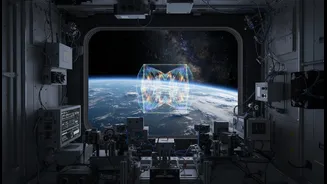



The Universe's Coolest Quantum Clubhouse
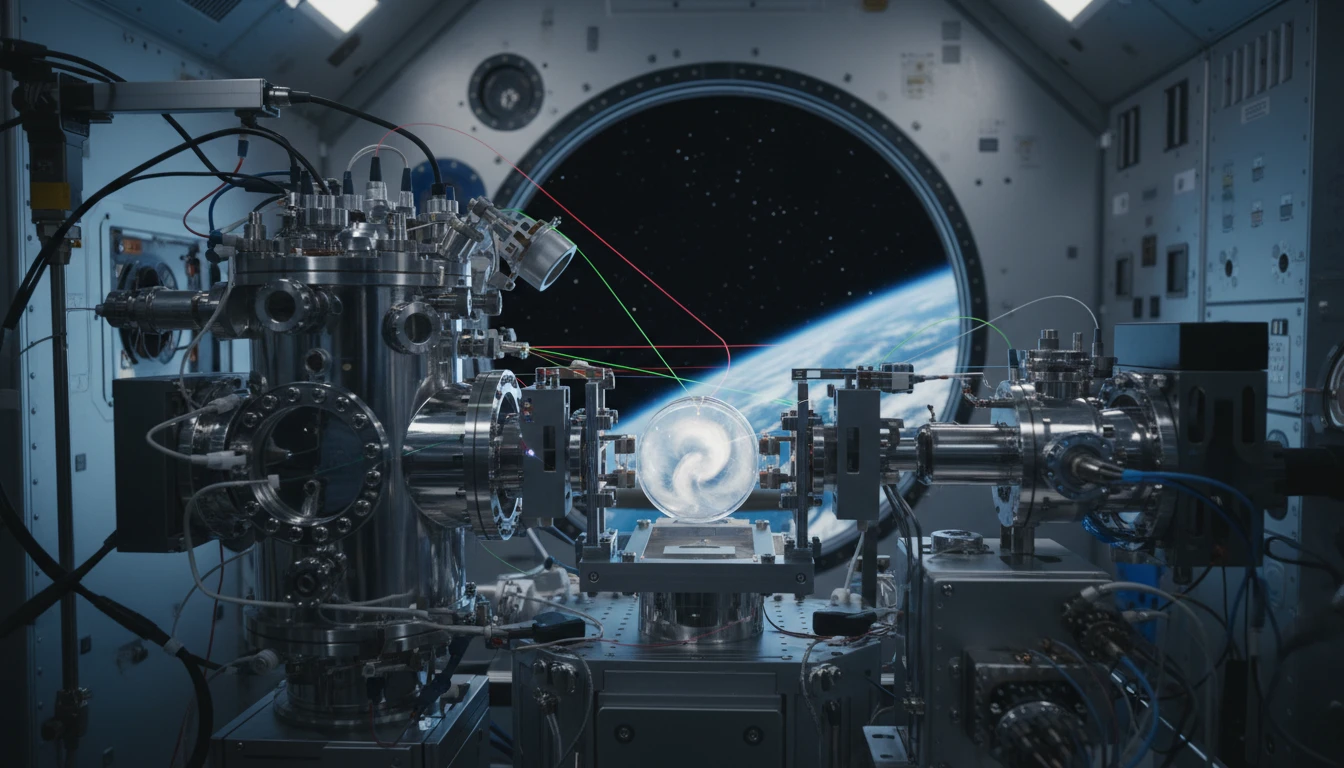
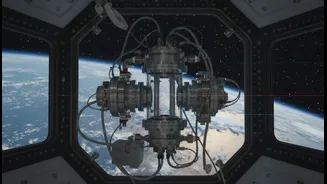
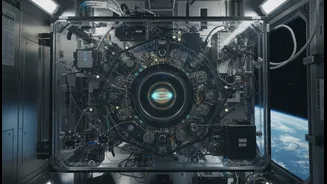
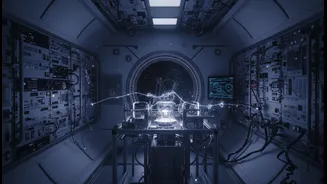
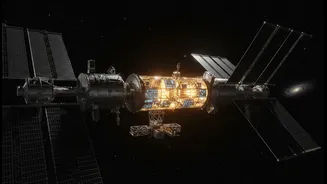
Orbiting 400 kilometres above Earth is a mini-fridge-sized box that is regularly the coldest known spot in the universe. This is NASA's Cold Atom Lab (CAL), a remarkable facility on the International Space Station (ISS) designed to study the weird and
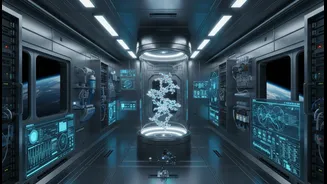
wonderful world of quantum mechanics. Its mission is to cool atoms down to just a fraction of a degree above absolute zero, the theoretical point where all atomic motion stops. At these extreme temperatures—colder than deep space—atoms stop behaving like tiny, zipping balls and start acting like waves. They can merge into a bizarre fifth state of matter called a Bose-Einstein Condensate (BEC), where the quantum properties of individual atoms become visible on a macroscopic scale. This allows scientists, who operate the lab remotely from Earth, to observe and manipulate matter in ways that are simply impossible anywhere else.
A Major Upgrade for Deeper Discovery
In a recent mission that concluded in mid-2026, the Cold Atom Lab received its latest significant upgrade, enhancing its capabilities for groundbreaking research. Astronauts installed new hardware, including a redesigned magnetic trap that offers greater control over the shape of the ultracold atom clouds. This allows researchers to probe the properties of these quantum gases with more flexibility. The upgrade also included improved atom sources, which are crucial for creating the initial gas clouds that are then cooled by lasers. These enhancements are not just minor tweaks; they represent a major leap forward, enabling scientists to create larger and more stable Bose-Einstein Condensates and study them for longer periods. According to NASA's Jet Propulsion Laboratory, which manages the mission, this upgrade pushes the boundaries of how closely we can control and investigate the quantum world.
Why Space is the Ultimate Laboratory
Conducting these experiments on Earth is incredibly challenging due to one fundamental force: gravity. Here on the ground, as soon as scientists create an ultracold atom cloud, gravity pulls it down, giving them only fractions of a second for observation before the sample is lost. The continuous free-fall environment of the ISS, however, effectively cancels out gravity's pull. This microgravity allows the delicate, slow-moving atom clouds to float, undisturbed, for much longer—up to several seconds. This extended observation time is crucial. It enables scientists to watch how these quantum states evolve and interact, and even allows the atoms to cool to even lower temperatures than what can be achieved on Earth. This unique advantage makes the ISS the perfect, and only, place for this kind of sustained, high-precision quantum research.
The Long-Term Promise of Quantum Tech
While the science happening in the Cold Atom Lab sounds esoteric, its long-term implications could be transformative. The fundamental research being conducted is a stepping stone toward a new generation of quantum technologies. One of the most promising applications is the development of ultra-precise sensors. Atom interferometers, which use the wave-like properties of these cold atoms, could be used to create navigation systems for spacecraft that don't rely on GPS, or to build instruments that can detect faint gravitational waves or even dark matter. These sensors could also be turned toward Earth, providing unprecedented detail for monitoring climate change, seismic activity, or underground resources. This work is also vital for improving atomic clocks, the backbone of modern timekeeping and navigation technologies like GPS.