



A Glimpse into the Cosmic Dawn
Astronomers using the combined power of the James Webb Space Telescope and the Gemini North telescope in Hawai'i have identified the most distant and oldest compact pair of quasars ever found. The system, named Nāpōwawāʻenakaulua, is seen as it was just
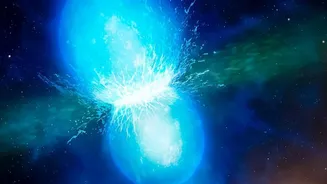
900 million years after the Big Bang, a period known as 'cosmic dawn' when the first stars and galaxies were igniting. This discovery is not just another dot in the sky; it's a direct observation of two galaxies in the process of merging, their central black holes lighting up as they feast on the resulting cosmic chaos. Finding one such massive object so early is a puzzle, but finding a pair this close together fundamentally challenges existing theories of cosmic evolution.
What Exactly Is a Quasar?
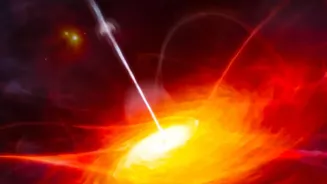
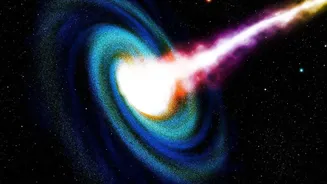
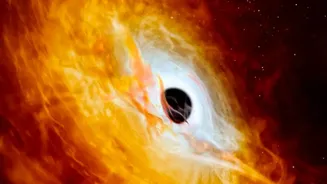
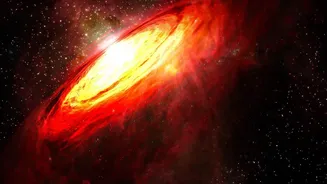
It's easy to get confused by the term, but a quasar is not the black hole itself. Rather, it is the intensely luminous region at the center of a galaxy powered by a supermassive black hole. As vast amounts of gas and dust are pulled toward the black hole, they form a swirling 'accretion disk'. The immense gravitational and frictional forces in this disk heat the material to millions of degrees, causing it to glow with more light than entire galaxies, sometimes thousands of times brighter than our own Milky Way. These brilliant beacons are some of the most powerful objects in the universe, acting as cosmic lighthouses that allow us to study the otherwise invisible supermassive black holes at their cores.
The 'How Big, So Fast?' Problem
The existence of Nāpōwawāʻenakaulua presents a major headache for astrophysicists. According to current models, it should take more than a billion years for a black hole to grow to the 'supermassive' stage by gradually consuming matter and merging with other black holes. Yet this pair, with estimated masses of 1.5 billion and 400 million times that of our sun, was already enormous just 900 million years after the universe began. The discovery of this pair, and others like it by the JWST, suggests that black holes in the early universe must have grown much, much faster than previously thought. Theories include the direct collapse of massive gas clouds or the existence of primordial 'seed' black holes formed shortly after the Big Bang.
Why Finding a 'Pair' Is So Important
Finding two quasars so close together—separated by only 18,100 light-years, a fraction of the Milky Way's diameter—is a smoking gun for galaxy mergers in the early universe. Such collisions are violent, chaotic events that funnel enormous amounts of gas toward the galactic centers, providing the fuel needed to ignite not one, but two quasars simultaneously. This observation provides a crucial piece of the puzzle, suggesting that the early universe was a far more crowded and dynamic place than we imagined. This system acts as a real-world laboratory, showing that these dramatic mergers were a key driver of black hole growth, potentially solving the 'how big, so fast?' problem. The team that found the pair suggests it may have formed in an unusually dense region of the primordial universe where interactions were more common.
A New Era of Cosmic Discovery
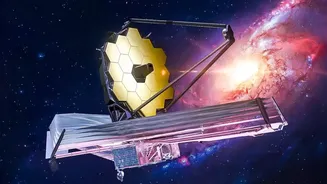
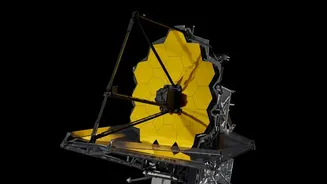
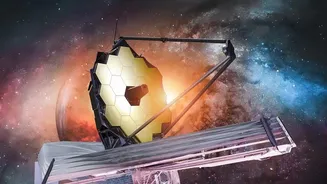
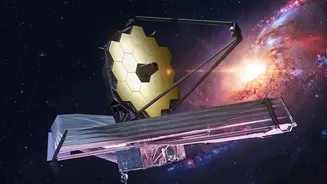
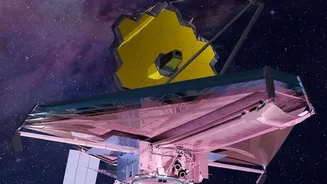
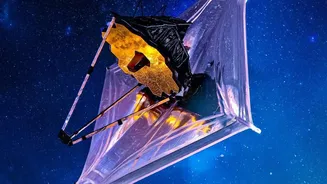
This finding was made possible by the unique capabilities of the JWST. Its powerful infrared instruments can peer through the cosmic dust that shrouds the early universe, revealing objects that are invisible to other telescopes. The discovery was part of the Aether survey, which is building a census of early universe objects. After spotting a faint companion next to a known quasar, astronomers used spectrographs on both Webb and Gemini North to analyze the light from each source separately. The distinct signatures confirmed they were two separate objects, not a single quasar whose light was being bent by a gravitational lens, though that possibility can't be entirely ruled out yet.