
Seeing with Radar
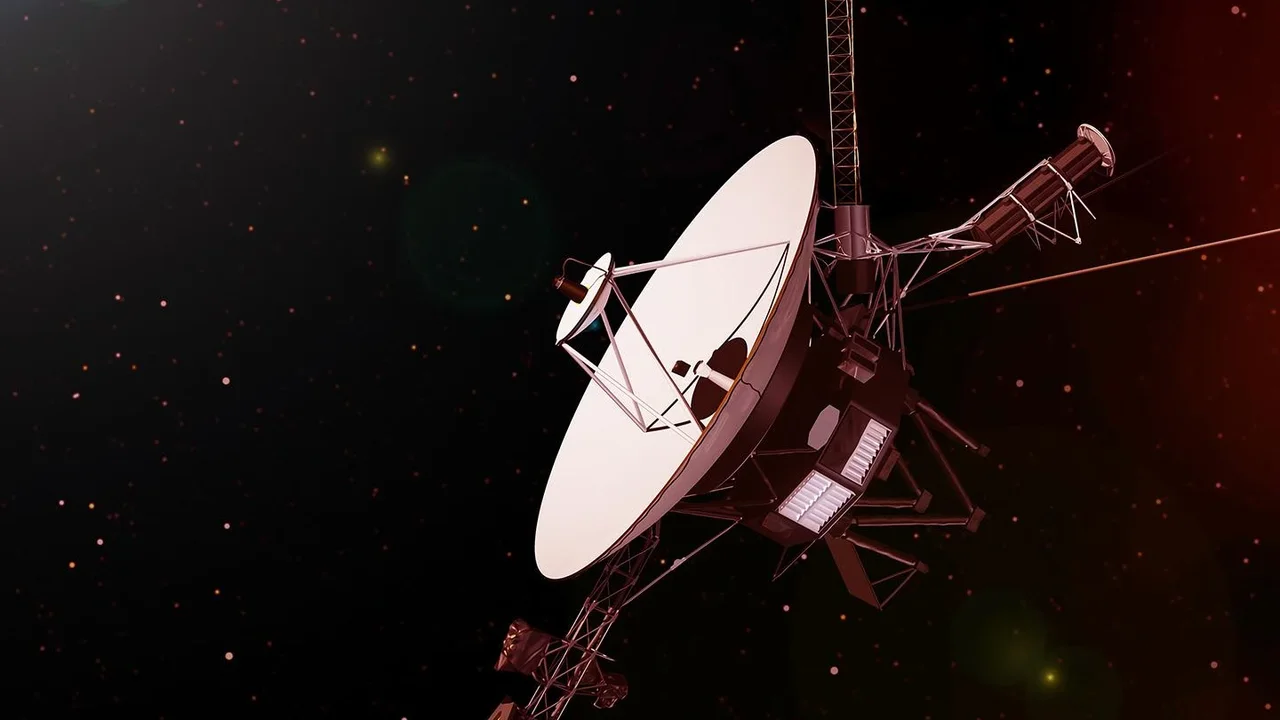
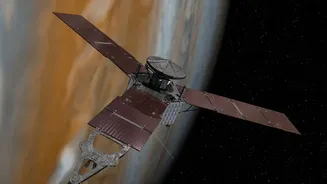
One of the most direct ways to 'see' through ice is with radar. Missions like NASA's Europa Clipper are equipped with a powerful instrument called an ice-penetrating radar. Think of it like a sophisticated ultrasound for a planetary body. The instrument,
known as REASON (Radar for Europa Assessment and Sounding: Ocean to Near-surface), sends radio waves down through the ice. These waves travel until they hit a boundary—like the one between solid ice and liquid water—and then bounce back. The radar doesn't go through water, so where the signal stops and reflects tells scientists where the ice ends and an ocean likely begins. By timing how long it takes for the signal to return, and how strong it is, researchers can map the thickness of the ice shell and identify potential pockets of water or even the top of the global ocean itself. This technology was honed right here on Earth, used for decades to study the deep structures of ice sheets in Antarctica.
Sensing a Magnetic Field
Another clever method involves magnetism. Giant planets like Jupiter have immense, powerful magnetic fields that rotate with the planet. As an icy moon like Europa orbits through this field, the magnetic forces change. If there's a global ocean of salty, electrically conductive water beneath the ice, this changing magnetic field will create, or 'induce,' a secondary magnetic field within the moon itself. A sensitive instrument on a visiting spacecraft, called a magnetometer, can detect this faint, induced field. The strength and characteristics of this secondary field give scientists vital clues. It helps them confirm the presence of a conductive layer—most likely a saltwater ocean—and can even provide estimates of the ocean's depth and salinity. The Galileo spacecraft first detected such a field at Europa, providing some of the strongest initial evidence for its hidden sea.
Measuring the Squeeze
Gravity provides another crucial piece of the puzzle. Just as our Moon’s gravity creates tides in Earth's oceans, the immense gravity of a planet like Jupiter squeezes and stretches its moons. This is called tidal flexing. Scientists can precisely measure how much a moon's surface deforms or bulges as it orbits. If Europa were solid ice all the way through, its surface would only bulge by about a metre. However, if a massive global ocean is sloshing beneath a floating ice shell, the surface should rise and fall by as much as 30 metres. Probes can measure these tiny changes in shape using laser altimeters, which bounce beams of light off the surface to create precise topographical maps. They also measure the moon’s gravity field directly. As a spacecraft flies over denser regions, it gets a slightly stronger gravitational tug. By mapping these variations, scientists can infer the internal structure, including the presence of a liquid layer that allows the surface to deform so dramatically.
Sniffing for Watery Clues
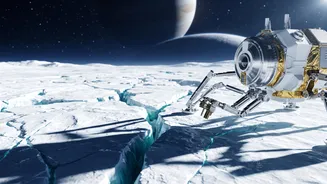
Sometimes, the moon gives up its secrets directly. On moons like Europa and Saturn's Enceladus, scientists have observed what appear to be giant plumes of water vapour erupting through cracks in the ice shell. These geysers offer a golden opportunity. Instead of having to drill through miles of ice, a probe can simply fly through one of these plumes. Instruments like mass spectrometers can then 'sniff' the material, analysing its chemical composition on the spot. Finding salt, organic molecules, and other minerals mixed in with the water vapour would be a direct confirmation that the plumes are sourced from a large, chemically rich subsurface ocean—one that might just have the right ingredients for life. This method allows a spacecraft to sample the ocean's contents without ever touching its surface.