




Our Invisible, Vulnerable Backbone
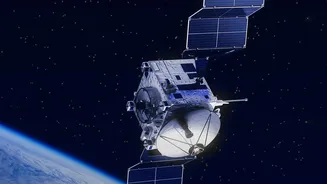
We rarely think about the invisible signals that power modern life. Every time you use a map on your phone, transfer money online, or even check the weather, you are relying on a vast, interconnected system of satellites and ground stations. This network
is the backbone of the global economy and critical infrastructure. However, its reliability is not guaranteed. These systems are vulnerable to a host of disruptions. Solar flares, for instance, can blast the Earth with electromagnetic radiation, potentially damaging satellites and interfering with radio signals. As our reliance on this technology grows, and as space becomes more crowded with satellites, the risk of significant communication breakdowns increases. A major outage could disrupt everything from aviation and shipping to power grids and emergency services.
Enter NASA's Cognitive AI
To address this challenge, NASA is developing a revolutionary solution: an artificially intelligent system designed to make communication networks think for themselves. Part of a project known as Cognitive Communications, this AI is being created to manage space networks without constant human oversight. Instead of relying on pre-programmed instructions from engineers on the ground, a cognitive network can sense its environment, identify potential problems in real-time, and adapt instantly to keep data flowing. This initiative, led by NASA's Glenn Research Center, aims to build resilience into the very fabric of our communication systems, making them smarter, more autonomous, and far more robust.
How It Thinks and Acts
So, how does a 'cognitive' network actually work? Imagine you are driving and your navigation app suddenly detects a massive traffic jam ahead. Without you doing anything, it instantly recalculates and gives you a faster, clearer route. NASA's AI does something similar, but for data travelling through space. If a solar flare threatens to disrupt a particular communication frequency, the AI can intelligently reroute the data to a different satellite or switch to an unused part of the electromagnetic spectrum. This ability to find these unused 'white spaces' is a key part of the technology. The AI can even learn from past events, becoming better over time at predicting and avoiding disruptions. This allows the network to self-heal and optimize its performance, ensuring that a mission's valuable data always has a safe path back to Earth.
More Than Just Space Travel
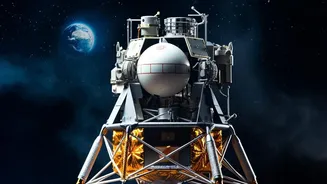
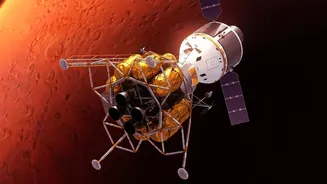
While this research is driven by the needs of complex space missions, like coordinating swarms of satellites or supporting future journeys with the Artemis program, its implications are enormous for life on Earth. The same principles that protect a Mars rover's data can be applied to protect our terrestrial networks. Think of the complex systems that manage financial transactions, coordinate national power grids, or provide mobile connectivity across India. By integrating this kind of cognitive AI, these systems could become far more resilient to cyber-attacks, technical failures, or even natural phenomena. The technology has potential applications for commercial satellite internet providers, government defence networks, and countless industries that depend on flawless data transmission.
The Future of Secure Connections
The development of cognitive communications is still an ongoing effort within NASA's Space Communications and Navigation (SCaN) program. Researchers are focused on refining the decision-making algorithms, known as cognitive engines, that power the system. The goal is to create a fully integrated network where every component, from the individual satellite link to the ground-based infrastructure, works together as a single, intelligent entity. While it may be some time before this technology is widely deployed, it represents a fundamental shift in how we approach network security. It moves us from a reactive model, where humans fix problems after they occur, to a proactive one, where an intelligent system prevents them from happening in the first place. This work is laying the foundation for a future where our digital connections are not just fast, but fundamentally safe and reliable.