



Mapping the Universe's Hidden Highways
Astronomers have long theorized that galaxies are not scattered randomly across space but are connected by a vast, web-like structure. This 'cosmic web' is thought to be made primarily of dark matter, an invisible substance that forms long filaments stretching
across the universe. Where these filaments intersect, matter clumps together, providing the gravitational seeds for galaxies to form. For decades, this web remained largely theoretical, its faint, diffuse nature making it nearly impossible to observe directly. However, recent breakthroughs are finally bringing this hidden architecture into focus. Scientists have captured the sharpest images ever of these cosmic filaments, some stretching millions of light-years and linking galaxies from when the universe was just a few billion years old. These structures act like intergalactic highways, channeling gas and dust into galaxies and fueling the birth of new stars.
New Eyes on the Ancient Cosmos
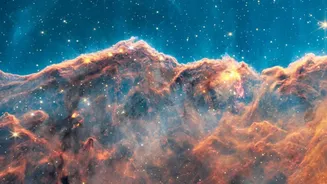
The latest discoveries are powered by a new generation of incredibly sensitive telescopes. NASA's James Webb Space Telescope (JWST), with its unparalleled ability to detect faint infrared light, has been instrumental in this effort. The COSMOS-Web program, the largest study ever conducted with JWST, is specifically designed to map this cosmic network, peering back 13.7 billion years to the universe's infancy. By combining JWST's data with observations from other powerful instruments like the Euclid space observatory and ground-based telescopes, scientists can pierce through the cosmic dust that once obscured our view. These multi-wavelength observations allow researchers to distinguish faint structures from background noise and confirm their existence, essentially creating a 3D map of the early universe in unprecedented detail.
Finding the 'Ghost Galaxies'
Beyond the giant filaments, the new data is also uncovering entirely new types of cosmic structures, like 'ghost galaxies'. One such object, dubbed CDG-2, is a diffuse, nearly invisible galaxy that appears to be made of 99% dark matter. These low-surface-brightness galaxies are incredibly difficult to spot because they contain very few stars. Astronomers found CDG-2 not by looking for the galaxy itself, but by spotting a tight grouping of globular star clusters, which acted like cosmic breadcrumbs leading to the hidden galaxy. The discovery of such dark-matter-dominated galaxies challenges our understanding of galaxy formation and suggests that the universe may be populated by many more of these faint objects than previously thought.
Rewriting Our Cosmic Story
Each new map and discovered structure forces scientists to refine their models of the cosmos. Some of these findings are challenging core assumptions. For instance, astronomers recently identified a massive cosmic filament containing hundreds of galaxies that appears to be rotating as a single, connected structure. This coordinated motion, stretching over tens of millions of light-years, is not easily explained by current theories of how galaxies gain their spin. Other discoveries, like the 'Big Ring,' a structure of galaxies 1.3 billion light-years in diameter, are so large that they defy the theoretical size limit for cosmic structures, hinting that our standard model of cosmology may need adjustments. These massive formations suggest that the universe might not be as uniform on the largest scales as previously believed.