





Lighthouses of the Cosmic Dawn
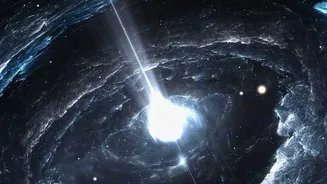
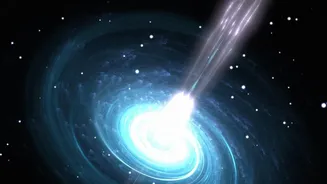
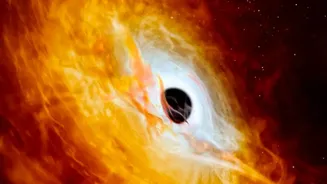
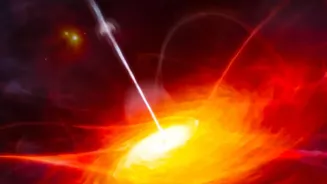
First, what exactly is a quasar? Imagine a black hole millions or even billions of times more massive than our Sun. Now, picture it actively feeding on a surrounding whirlpool of gas, dust, and stars. This material, called an accretion disk, heats up
to incredible temperatures from friction and gravitational forces, causing it to glow with an intensity that can outshine entire galaxies. This intensely bright object is a quasar. Because they are so luminous, they act as cosmic lighthouses, allowing astronomers to study the conditions of the very early universe, a period known as the 'Cosmic Dawn'. Seeing them is like looking back in time to when the first stars and galaxies were just beginning to form.
A Discovery That Shouldn't Exist
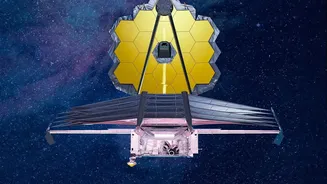
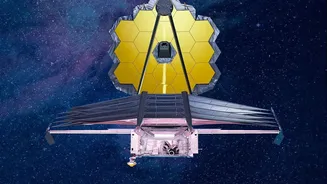
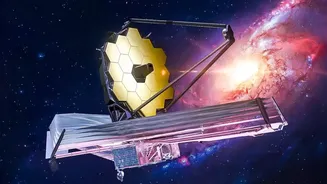
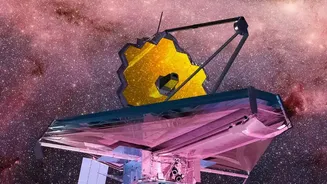
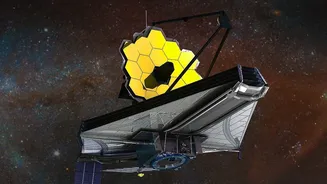
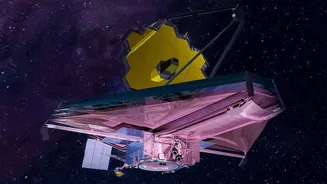
The latest discovery, made with the JWST and confirmed with the Gemini North telescope in Hawai'i, is a system officially named J1602+4228AB. It consists of two quasars seen as they were a mere 900 million years after the Big Bang. This alone is remarkable, but what makes it truly baffling for scientists is their sheer size and proximity. One black hole is estimated to be 1.5 billion times the mass of the Sun, while its companion is around 400 million solar masses. They are separated by only 18,100 light-years—a tiny distance in cosmic terms, about one-fifth the diameter of our own Milky Way galaxy. According to our current models of the universe, there simply shouldn't have been enough time for black holes to grow this massive, let alone for two of them to be found so close together.
Solving the 'How So Big, So Fast?' Puzzle
This discovery provides a crucial piece of a long-standing puzzle: how did supermassive black holes (SMBHs) get so enormous so early in the universe's history? The conventional wisdom is that black holes grow by consuming matter or by merging with other black holes, processes that should take billions of years. Finding such giants in the universe's infancy challenges everything. The Nāpōwawāʻenakaulua pair—a Hawaiian nickname meaning 'Two celestial bodies of fathomless powerful darkness'—strongly suggests that galaxy mergers were a key ingredient for rapid growth. Astronomers believe this pair represents two galaxies in the process of colliding. Such a merger would create an environment incredibly rich in gas and dust, providing a feast for the black holes at their centers and accelerating their growth at an astonishing rate.
A Glimpse of Cosmic Assembly
This quasar pair isn't just a curiosity; it's a natural laboratory for studying how the first massive galaxies came together. The system was likely located in an exceptionally dense region of the early universe, where the pull of gravity was extreme. This density would have fueled not only the rapid growth of the black holes but also furious star formation as the host galaxies smashed into each other. By observing this ongoing merger, scientists get a direct view of the chaotic, powerful processes that shaped the large-scale structure of the cosmos we see today. Theories have long predicted that such mergers were common in the early universe, but this is the first time a pair has been confirmed in the Epoch of Reionization, the period when the first light sources burned through the primordial darkness.