
India's Next Interplanetary Leap
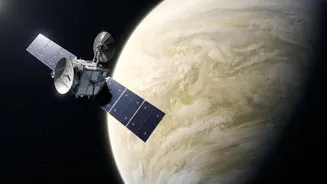
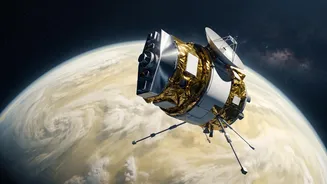
Following the historic successes of the Chandrayaan lunar missions and the Mangalyaan Mars orbiter, the Indian Space Research Organisation (ISRO) is setting its sights on our other planetary neighbour. The Venus Orbiter Mission, unofficially known as
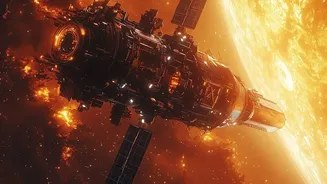
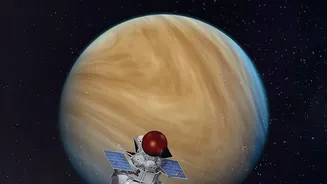
Shukrayaan, represents India's first foray to the second planet from the sun. Approved by the Union Cabinet in September 2024, the mission is currently slated for a March 2028 launch. This endeavour places India in a select group of space agencies aiming to unravel the mysteries of Venus, contributing a unique perspective to global planetary science. The mission's primary goals are to study Venus’s surface, its dense atmosphere, and the complex interaction it has with the ever-present solar wind.
Venus: A Tale of a Twin Gone Wrong
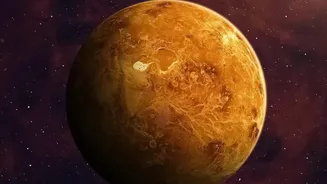
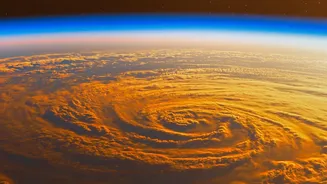
At first glance, Venus and Earth are remarkably similar. They are nearly the same size, mass, and rocky composition. But the similarities end there. Venus is a cautionary tale of a runaway greenhouse effect. Its atmosphere, over 90 times denser than Earth's, is composed of 96.5% carbon dioxide. This thick blanket traps heat, pushing surface temperatures to a staggering 460 degrees Celsius—hot enough to melt lead. The planet is perpetually covered by thick, opaque clouds not of water, but of corrosive sulfuric acid, which race around the upper atmosphere at speeds faster than any storm on Earth. This extreme pressure and heat make exploration incredibly difficult; the longest any lander has survived on the surface is just over two hours.
Peering Beneath the Corrosive Veil
The main challenge for any Venus orbiter is its impenetrable cloud cover. To understand the planet’s geology and surface processes, you have to see through this layer. This is where Shukrayaan's advanced sensor array comes in. The mission's flagship instrument is a high-resolution Synthetic Aperture Radar (SAR), a powerful imaging technique that can pierce through clouds and darkness to map the surface below. ISRO’s SAR is designed to have a resolution up to four times better than NASA's Magellan orbiter from the 1990s, promising an unprecedented look at Venus’s volcanoes and geological features. This radar will be key to searching for signs of active volcanism and understanding the planet’s mysterious terrain.
The Scientific Eyes of Shukrayaan
Shukrayaan will carry a payload of around 100 kg, featuring approximately 19 instruments from both India and international partners like Sweden, Russia, and Germany. One of the most groundbreaking instruments will be a ground-penetrating radar—a world-first for Venus exploration. This will allow scientists to study the subsurface stratigraphy, looking for buried lava channels and clues about the planet's geological history. Other instruments will include thermal cameras to monitor cloud temperatures and spectrometers to analyze the atmospheric composition. A key collaborative payload, VIRAL, will study atmospheric gases, including searching for any traces of phosphine, a gas that has been speculatively linked to biological processes.
Why We Study a Hellish World
Exploring a planet as inhospitable as Venus isn't just about curiosity; it's about understanding our own home. Because Venus and Earth likely started so similarly, figuring out why their evolutionary paths diverged so dramatically is a top priority for planetary scientists. Venus serves as a natural laboratory for studying extreme greenhouse effects, providing invaluable data for our own climate models. Unlocking its secrets—how it lost its water, how its atmosphere evolved, and whether it ever harboured life—could help us better understand the conditions that make a planet habitable and preserve Earth's future.