




A Planet of Polygons
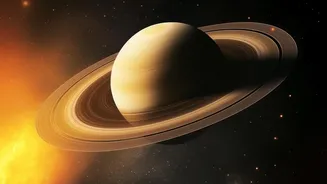
When we think of Saturn, we picture its magnificent rings. But the planet itself is just as captivating. For over 40 years, scientists have been mystified by a colossal six-sided jet stream churning around its north pole. This feature, known as 'the hexagon',
is wider than Earth and has remained remarkably stable since it was first spotted by the Voyager probes in the 1980s. For years, astronomers wondered if a similar shape existed at the south pole. The Cassini spacecraft, which orbited Saturn from 2004 to 2017, found no such southern counterpart, deepening the mystery. But recent observations have revealed something entirely new and unexpected. Using the Hubble Space Telescope, scientists have confirmed the emergence of a 10-sided atmospheric wave—a decagon—circling the planet's south pole.
The Decagon's Recent Arrival
What makes the decagon so significant is that it's a new development. Tracing back through Hubble images, researchers found faint hints of the structure appearing in 2023 before becoming a more defined pattern in 2024 and 2025. This is a dramatic change from the previous decades of observation, which showed no such long-lived feature. The discovery was made possible by the Outer Planet Atmospheres Legacy (OPAL) program, which uses Hubble to take annual snapshots of our solar system's outer planets. This regular monitoring allowed scientists to spot the feature as it evolved, offering a rare opportunity to watch a large-scale atmospheric structure develop in almost real-time. The decagon appears to be strengthening, providing a front-row seat to planetary dynamics that usually unfold over immense timescales.
An Atmospheric Wave in a Jet Stream
Like its northern hexagonal cousin, the southern decagon is not just a surface-level cloud pattern. It is a massive atmospheric wave embedded within one of Saturn's powerful jet streams, where winds can race at around 400 to 420 kilometers per hour. Observations show the decagon is a deep, vertically extended structure that reaches through multiple layers of the atmosphere. Scientists can probe different altitudes by viewing the planet in various wavelengths of light, and the decagon is visible across them. The shape itself is thought to be a type of standing wave, a phenomenon that can occur in rotating fluids. Laboratory experiments have shown that when a circular tank of liquid is spun at different speeds, stable polygons with three to eight sides can form at the boundary. The greater the difference in speed, the more sides the polygon has. The conditions on Saturn, with its powerful, shearing jet streams, are a perfect natural laboratory for creating these strange geometries.
Why This Discovery Is Important
The existence of the decagon is important for several reasons. First, it proves that Saturn's famous hexagon is not a one-off anomaly. It suggests the underlying physics in Saturn's atmosphere are conducive to forming stable polygonal waves in both hemispheres. Second, its recent formation challenges the idea that the features of giant planets are timeless and unchanging. Scientists now have to figure out what triggered its sudden appearance. One leading suspect is a nearby anticyclone—a high-pressure vortex—that may have provided the initial disturbance needed to kickstart the wave. Studying how and why the decagon formed can provide invaluable insights into the complex fluid dynamics that govern the atmospheres of gas giants. Understanding these mechanisms on Saturn helps scientists model weather on Jupiter and even on exoplanets far beyond our solar system. The decagon is a brand-new piece in the grand puzzle of how planetary atmospheres work.