
Our New Eyes on the Cosmos
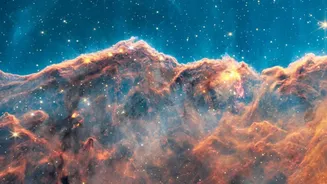
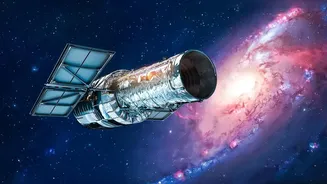
At the forefront of this revolution is the James Webb Space Telescope (JWST), an observatory designed to see the universe in infrared light. This allows it to peer through cosmic dust clouds that obscure the view of other telescopes, like Hubble, revealing
the hidden nurseries of stars and the faint light of the universe's oldest galaxies. Launched in 2021, JWST is the world's premier space science observatory, an international program led by NASA with its partners, the European Space Agency (ESA) and the Canadian Space Agency (CSA). Its massive mirror and sophisticated instruments are providing a flood of data and breathtaking images that are helping scientists tackle some of the biggest questions in astronomy.
Mapping the Universe's Grand Architecture
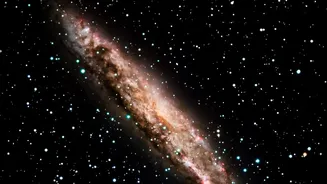
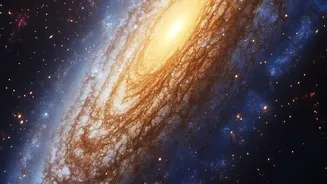
One of the most profound mysteries is how the universe is structured. On the grandest scale, galaxies are not scattered randomly; they are arranged in a vast, filamentary structure known as the cosmic web. Using JWST, astronomers have created the most detailed map of this web to date, tracing its threads back to just a billion years after the Big Bang. A recent study identified a 3-million-light-year-long string of ten galaxies from this early era. This unprecedented resolution helps scientists understand how the underlying architecture of the cosmos, believed to be formed by dark matter, guided the evolution of the galaxies and clusters we see today.
Solving the Puzzle of Star Birth
Understanding how stars form is fundamental to understanding our own origins. High-resolution images are providing fresh insights into this process. While it was long believed that dramatic galaxy mergers were the primary event that shut down star formation, new research suggests slower, internal processes are more significant. Studies using instruments like the Atacama Large Millimeter/submillimeter Array (ALMA) have, for the first time, measured the building blocks of stars in another galaxy, the Large Magellanic Cloud. The findings suggest that the very initial stages of star formation might be universal, following similar patterns across different galactic environments, even if the later stages differ. Separately, some astronomers are now proposing a new category of 'red star-forming' galaxies, which could mean the universe has created far more stars than previously estimated.
Discovering Hidden Worlds
Beyond distant galaxies, these powerful new eyes are revolutionizing the search for planets around other stars, known as exoplanets. In a remarkable discovery from July 2026, astronomers using JWST found a giant planet, named Beta Pictoris d, hiding in one of the most famous and well-studied planetary systems. It was not found through direct imaging, but by detecting the unique chemical signature of its atmosphere through the system's bright dust disk. This showcases a powerful new method for finding elusive exoplanets, especially those concealed by cosmic debris. The discovery makes Beta Pictoris only the second known system with at least three directly imaged planets, providing a crucial laboratory for understanding how planetary systems like our own form and evolve.