



The Cosmic Dance of Galaxies
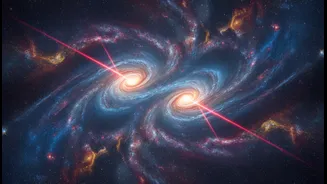
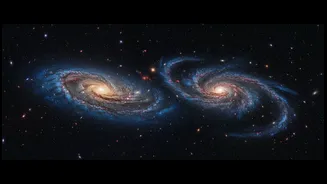
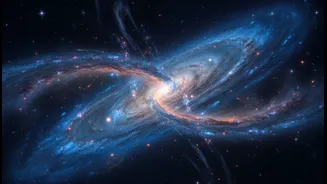
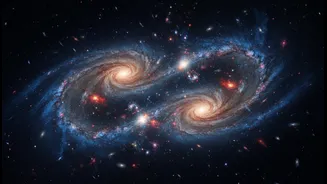
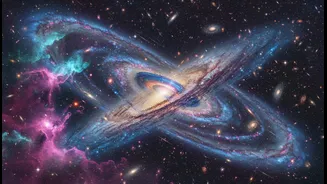
A galaxy merger isn't a head-on car crash. Instead, it’s a gradual, gravitationally-led process that can take hundreds of millions of years. When two galaxies draw near, their mutual gravity pulls them into a complex orbit. They might pass through each
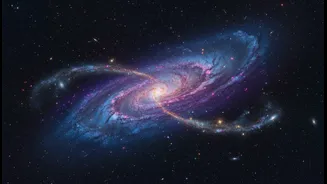
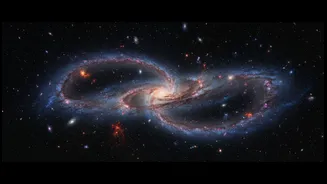
other several times, their structures warping and distorting with each pass. During this cosmic ballet, individual stars almost never collide due to the immense distances between them. However, the vast clouds of gas and dust within each galaxy are not so lucky. These clouds, the raw ingredients for new stars, are dramatically affected by the encounter. Famous examples like the Antennae or Mice galaxies give us a stunning visual snapshot of this process, with long, streaming filaments of stars and gas being pulled from the main galactic bodies.
Understanding Gravitational Tides
The key force at play is the gravitational tide. It’s the same principle that causes oceans to bulge on Earth, but on an unimaginable scale. A tidal force is essentially a stretching force caused by a difference in gravitational pull across an object. As two galaxies interact, the side of one galaxy closer to its partner feels a stronger gravitational pull than the far side. This differential pull stretches both galaxies, distorting their shapes and flinging streams of stars and gas into space, forming what astronomers call tidal tails. But this stretching is only half the story; in other areas, these same forces create immense compression, which is the crucial trigger for what comes next.
Squeezing the Star Fuel
Galaxies are filled with enormous, diffuse clouds of cold gas and dust, known as molecular clouds. In a stable, isolated galaxy like our own Milky Way, these clouds may float peacefully for eons, forming stars at a relatively steady pace. But a galactic merger violently disrupts this equilibrium. The powerful tidal forces, combined with shockwaves from the colliding gas, act like a cosmic piston. They compress the gas clouds, dramatically increasing their density. Furthermore, the gravitational chaos causes these clouds to lose momentum and fall rapidly toward the centre of the merging system, creating a massive concentration of star-forming fuel in a compact region.
The 'Starburst' Ignition
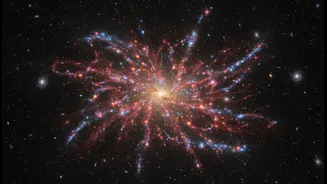
This sudden, extreme compression is the final trigger for a 'starburst'. When a gas cloud becomes dense enough, its own gravity takes over, causing it to collapse into dense cores. These cores continue to contract and heat up until nuclear fusion ignites, and a new star is born. In a merger, this happens to countless clouds all at once. The rate of star formation can skyrocket to hundreds, or even thousands, of times that of a normal galaxy. This is the 'intense explosion' of the headline—not a blast of destruction, but a dazzling, galaxy-wide baby boom of new stars. These new stars, many of them massive and brilliantly blue, make the galaxy exceptionally luminous.
A Short-Lived Blaze of Glory
A starburst phase is spectacular but fleeting. The very intensity of the star formation quickly uses up the available gas supply. The most massive of these new stars also live fast and die young, exploding as supernovae within just a few million years. These supernova explosions, along with powerful stellar winds, can help blow the remaining gas out of the galaxy, effectively shutting down star formation. This whole frantic episode of creation might only last for about ten million years, a mere blip in the multi-billion-year lifespan of a galaxy. What’s left is often a new, larger, and more spheroidal galaxy, filled with a generation of new stars but depleted of the gas needed to make more.