

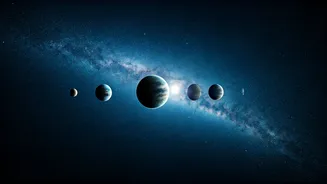


What Is This Celestial Gathering?
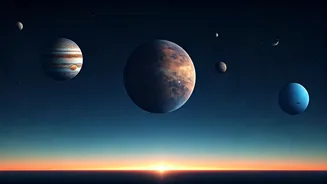
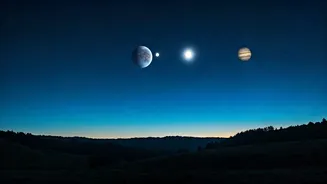
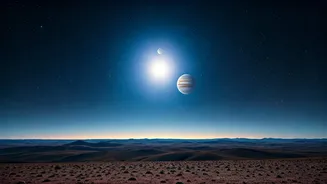
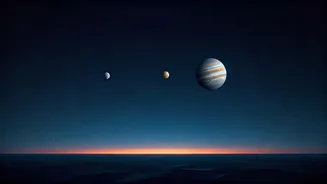
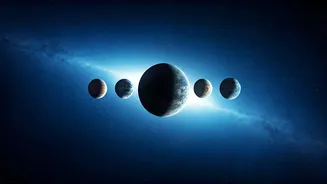
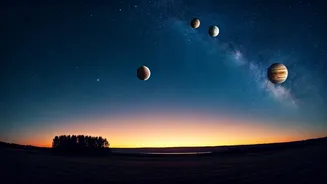
In simple terms, three of our solar system’s most fascinating planets — Mercury, Venus, and Jupiter — are appearing very close to each other in our sky shortly after sunset. This type of event is often called a planetary alignment or a conjunction. From
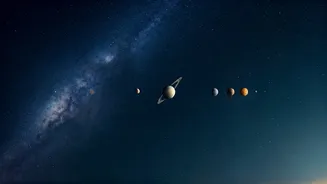
our vantage point on Earth, the planets appear to be lined up in a neat row or clustered together. This isn't a sign of anything cosmic or chaotic; it's a beautiful trick of perspective. As the planets orbit the Sun at different speeds and on different paths, our line of sight to them occasionally makes them look like neighbours. It's a bit like seeing two friends standing far apart on a long road, but from your angle, they look like they are standing side by side.
The 'Planetary Parade' Illusion
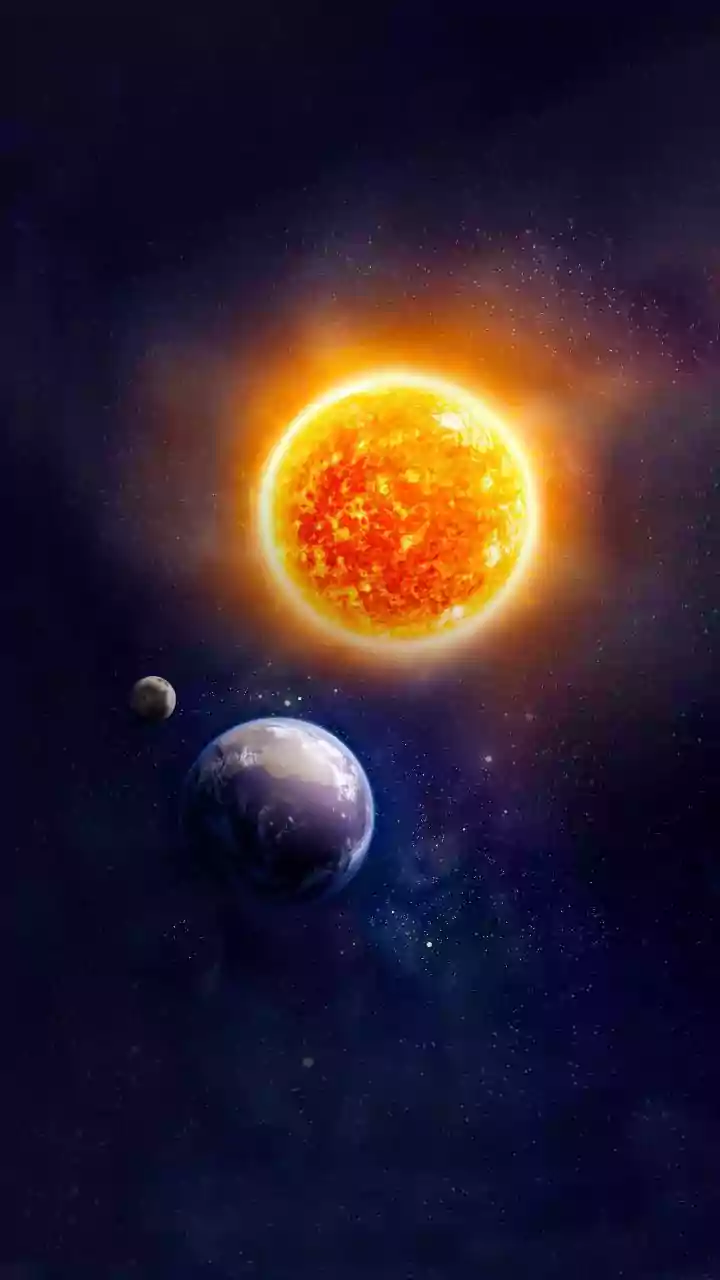
It’s crucial to remember that these planets are not actually close to each other in space. In reality, they remain hundreds of millions of kilometres apart. Venus, our closest planetary neighbour in this trio, is still tens of millions of kilometres away. Jupiter, the gas giant, is on the other side of the asteroid belt, vastly more distant. And Mercury is zipping around the Sun on its own tight orbit. The 'alignment' is purely a visual effect from our specific viewpoint on Earth. Think of it as a celestial photo-op, where planets that are usually scattered across the sky decide to pose together for a brief period. This illusion is what makes these events so special and visually compelling for us observers down below.
Why This Trio Is So Special
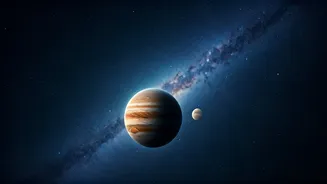
So, why the excitement over these three in particular? It comes down to star power, quite literally. Venus is the brightest object in the night sky after the Moon, often called the 'Evening Star' or 'Morning Star' for its brilliant, steady light. Jupiter is the next brightest planet, a commanding presence that outshines all the actual stars. Mercury, however, is the elusive one. As the closest planet to the Sun, it's often lost in the solar glare and is only visible for brief windows after sunset or before sunrise. To have all three — the two brightest planets and the hardest-to-spot inner planet — all visible together in the same patch of sky is a rare treat. It’s a convergence of accessibility and rarity that gets even casual sky-watchers excited.
Decoding the 'Breaking Media' Hype
The phrase 'breaking space media' is, of course, hyperbole. The planets are not physically 'breaking' anything. But the event is causing a significant stir for a few good reasons. First, it’s incredibly photogenic. Astrophotographers love these alignments because they create stunning compositions. Second, it's accessible. Unlike a faint nebula or a distant galaxy, you don't need an expensive telescope to see this. A clear view of the western horizon is enough. This democratic nature of the event means everyone can participate, leading to a flood of social media posts and news articles. It’s not 'breaking' in a disruptive sense, but 'breaking' through the noise of the everyday news cycle to give us a moment of collective wonder.
How to Watch From India
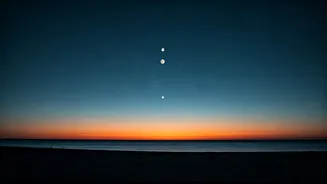
The best part is how easy it is to see this spectacle. You don't need any special equipment, though a pair of binoculars will certainly enhance the view. The key is timing and location. Find a spot with an unobstructed view of the western horizon—think open fields, a high balcony, or a terrace. The show begins shortly after the sun goes down. As the twilight deepens, look towards the area where the sun just set. The first to appear will be brilliant Venus, impossible to miss. Soon after, the golden glow of Jupiter will pop into view nearby. The biggest challenge will be spotting Mercury, which will be fainter and closer to the horizon. Give your eyes a few minutes to adjust to the darkness, and you should be able to see all three painting a beautiful, fleeting line in the evening sky.